Artist Biography

Luigi Lucioni

(1900 - 1988)

Table of Contents

    I. Biography

    “My chief desire in art, aside from the genuine pleasure that the craft of painting gives me, is to paint not just what I see but what I know and feel about objects and nature.”

     — Southern Vermont Art Center, An Exhibition of Paintings by Luigi Lucioni (Southern Vermont Art Center, 1960), exhibition catalog, September 10, 1960. 

    An Italian immigrant who spent most of his life in the United States, Luigi Lucioni has been described as an “individual realist who followed his own path,” distinguished by a meticulous and highly precise technique that captured what he termed the essential reality of his subjects.1 A few years after arriving in the United States, Lucioni won a competition that earned him admission to Cooper Union at the age of fifteen. There, he received his first formal artistic training under William Starkweather, studying geometric drawing, antique casts, portraiture, and life drawing over a period of four years.

    At nineteen, Lucioni continued his studies at the National Academy of Design under William Auerbach-Levy. His artistic development was further enriched in 1924 when he received a fellowship from the Louis Comfort Tiffany Foundation, a pivotal opportunity that enabled him to return to Italy. There, he studied the works of Renaissance masters such as Piero della Francesca, Andrea Mantegna, and Leonardo da Vinci. This experience profoundly shaped his distinctive realist style, characterized by meticulous attention to detail, exceptional technical skill, pristine surfaces, vivid color harmonies, and a strong emphasis on underlying form and structure

    Lucioni moved to Vermont in 1939 after visiting his cousin there and meeting Electra Havemeyer Webb, who would become his most important patron. He found lifelong inspiration in Vermont, declared himself a New England painter, and joined a broader national movement away from the country’s urban centers. Although European modernism gained prominence in the United States during the 1930s, Lucioni remained committed to realism—or what he called “super realism”—while resisting stylistic categorization.

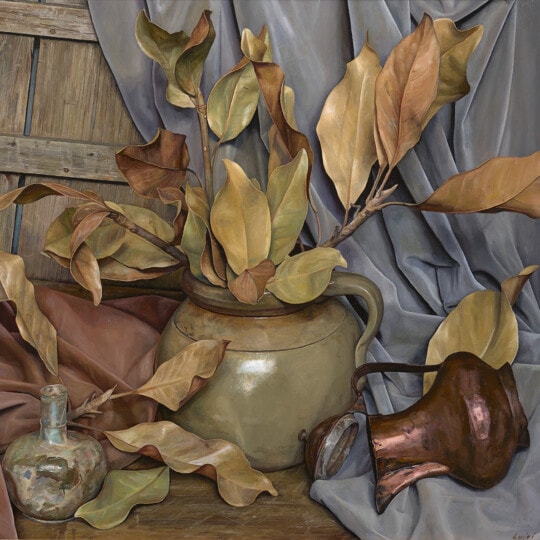
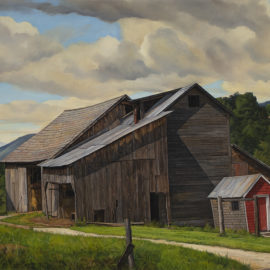
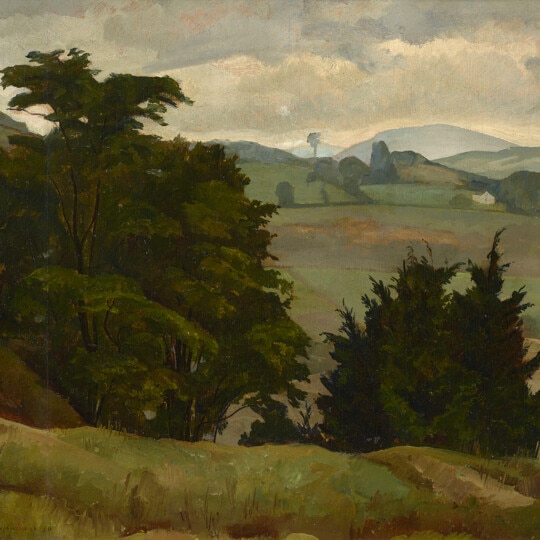
    Although best known for his precisely rendered still lifes and the detailed Vermont landscapes he painted during his summer sojourns, Lucioni also produced a significant body of compelling portraiture. He frequently linked his interest in portrait painting to his lifelong passion for music, particularly opera.

    Lucioni painted every day and was completely devoted to his craft, believing that draughtsmanship was the foundation of beautiful art. Throughout his distinguished career, he received numerous honors, including first prize at the Carnegie International Exhibition in 1939 for his portrait of Ethel Waters and recognition at the Corcoran Biennial in 1941 for his portrait of John La Farge, among many other distinctions.

    II. Chronology

    • 1900 Born on November 4th in Malnate, Italy to Angelo and Maria Beati Lucioni
    • 1906 Angelo Lucioni emigrates to New York City, finding work as a coppersmith and tinsmith
    • 1911 On July 15th, Luigi, his mother, and his three sisters, Angela, Alice and Aurora, board the ship Duke of Genoa, landing in New York City on August 9th at Ellis Island
    • 1915 Luigi is admitted to Cooper Union where he studies drawing shapes, heads, and life studies for four years
    • 1917 Makes the first of many annual visits to Barre, Vermont to spend time with his father’s second cousin Bartolomeo Roncoroni
    • 1919 Begins taking classes at the National Academy of Design in New York City
    • 1922 Produces first etching entitled Man Reading and experiments with the form for several years. The Associated American Artists of New York City publishes more than 75 of his etchings over a span of 50 years. 
    • 1924 Receives first fellowship from the Louis Comfort Tiffany Foundation, which includes a $200 scholarship and an invitation to live and work at Tiffany’s estate at Cold Spring Harbor on Long Island, New York. He receives this honor until 1932. 
    • 1925 Travels to Italy, returning to New York City in 1927 and again in 1929, setting up a studio at 64 Washington Square South, New York City
    • 1927 Under the encouragement of Tiffany Foundation director Stanley Lothrop, Lucioni is granted his first solo exhibition at Frederic Newlin Price’s Feragil Galleries, located at 37 East Fifty-seventh Street in New York City. He continues to exhibit with Feragil in 1928, 1930-35, 1937, and 1939. 
    • 1928 Receives a bronze medal from the L.C. Tiffany Foundation
    • 1929 Awarded the Medal of Honor for a portrait of his sister Alice
    • 1931 Meets Electra Havemeyer Webb and is commissioned to paint a composition for Webb’s daughter, Electra Bostwick. Lucioni begins to spend summers in Shelburne, Vermont.  He is commissioned by Minneapolis lawyer and investor George P. Douglas to paint Village of Stowe, Vermont for $1,000. 
    • 1932 The Metropolitan Museum of Art’s purchase of Dahlias and Apples (1931) renders Lucioni the distinction of being the youngest contemporary American artist with work in the museum’s collection at the time 
    • 1932 The Whitney Museum of American Art acquires Victorian Still Life (1931)
    • 1934 The Metropolitan Museum of Art exchanges Dahlias and Apples (1931) for an earlier still life, Pears with Pewter (1930)
    • 1934 Stowe Hollow (1933)is the first etching by Lucioni printed by Associated American Artists
    • 1937 Life Magazine dubs Lucioni as the “painter laureate” of Vermont
    • 1939 Lucioni purchases a home and studio in Manchester, Vermont for $6,500. The young artist reported, “I am now a landowner, a lovely house and two magnificent barns, five acres of charming land, and it is all my own. I am thrilled.”
    • 1939  Awarded first prize at the Carnegie International Exhibition
    • 1941 Elected full academician of the National Academy of Design
    • 1945 Establishes a new studio at 33 West Tenth Street in New York City, working there in the winters while spending time at his home in Manchester during the summers
    • 1968 Shelburne Museum presents Lucioni’s first loan retrospective exhibition 
    • 1968 The film, The Art of Luigi Lucioni, is released by Vermont Educational Television
    • 1988 Dies on July 22nd at his home in Greenwich Village, New York City

    III. Collections

    • Addison Gallery of American Art, Phillips Academy, Andover, Massachusetts
    • Butler Institute of American Art, Youngstown, Ohio
    • Canton Museum of Art, Canton, Ohio
    • Carnegie Museum of Art, Pittsburgh, Pennsylvania
    • Dallas Museum of Art, Dallas, Texas
    • Denver Art Museum, Denver, Colorado
    • Fleming Museum, University of Vermont, Burlington, Vermont
    • Georgia Museum of Art, University of Georgia, Athens, Georgia
    • Maier Museum of Art, Randolph College, Lynchburg, Virginia
    • The Metropolitan Museum of Art, New York, New York
    • Minneapolis Institute of Arts, Minneapolis, Minnesota
    • Mobile Museum of Art, Mobile, Alabama
    • Munson Museum, Utica, New York
    • Museum of Art at Brigham Young University, Provo, Utah
    • Neuberger Museum of Art, Purchase, New York
    • Noyes Museum of Art, Stockton University, Hammonton, New Jersey
    • Paine Art Center, Oshkosh, Wisconsin
    • San Diego Museum of Art, San Diego, California
    • Seattle Art Museum, Seattle, Washington
    • Shelburne Museum, Shelburne, Vermont
    • Sheldon Museum of Art, Lincoln, Nebraska
    • Smith College Museum of Art, Northampton, Massachusetts
    • Smithsonian American Art Museum, Washington D.C.
    • Telfair Museum of Art, Savannah, Georgia
    • The Arkell Museum at Canajoharie, Canajoharie, New York
    • The Bennington Museum, Bennington, Vermont
    • The Brooklyn Museum of Art, Brooklyn, New York
    • The John & Mable Ringling Museum of Art, Sarasota, Florida
    • The John H. Vanderpoel Art Association, Chicago, Illinois 
    • The Nelson-Atkins Museum of Art, Kansas City, Missouri
    • The Pennsylvania Academy of the Fine Arts, Philadelphia, Pennsylvania
    • The Toledo Museum of Art, Toledo, Ohio
    • The Vermont Historical Society, Montpelier, Vermont
    • University of Michigan Museum of Art, UMMA, Ann Arbor, Michigan
    • University of Saint Joseph Art Gallery, West Hartford, Connecticut
    • University of Wyoming Art Museum, Laramie, Wyoming
    • Washington County Museum of Fine Arts, Hagerstown, Maryland
    • Weisman Art Museum, Minneapolis, Minnesota
    • Whitney Museum of American Art, New York, New York
    • Wright Museum of Art, Beloit College, Beloit, Wisconsin

    IV. Exhibitions

    • 1927-28, 1930-35, 1937, and 1939 Ferargil Galleries, New York, New York
    • 1927 Allied Artists of America, American Fine Arts Building, New York, New York, The Allied Artists of America Fourteenth Annual Exhibition
    • 1937 National Academy of Design, New York, New York, 112th Annual Exhibition
    • 1943  Associated American Artists Galleries, New York, New York, Luigi Lucioni 
    • 1968 Shelburne Museum, Shelburne, Vermont, The Painting Life of Luigi Lucioni
    • 1992 Richard York Gallery, New York, New York, American Figurative Art

    V. Memberships

    • National Academy of Design
    • Allied Artists of America
    • Society of American Etchers (Brooklyn)

    VI. Notes

    1. 110 Years of American Art, 1830–1940: October 15–December 31, 2001 (New York: Ira Spanierman Gallery, 2001), 119-20.

    VII. Suggested Resources 

    • David Brody et al., Luigi Lucioni: Modern Light (Rizzoli Electra, 2022). 
    • Stuart P. Embury, The Art and Life of Luigi Lucioni: a Contribution Towards a Catalogue Raisonne (Embury Publishing, 2006). 

    Interested in Luigi Lucioni?

    Fill out the form below

    Interested in Artist