Artist Biography
Julian Walbridge Rix
(1850 - 1903)
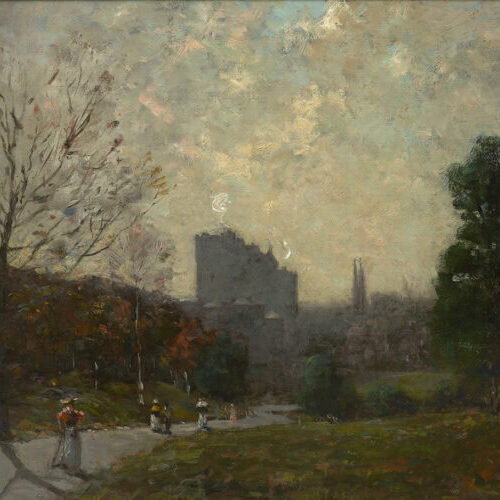
Despite his lack of formal artistic training, Julian Walbridge Rix is regarded as one of the earliest and most significant practitioners of the Barbizon style in California. Rix was born on December 30, 1850, in Peacham, Vermont and moved to San Francisco with his family early in his youth, returning, however, to Vermont to complete his education. After finishing school, Rix moved back to San Francisco. His first exposure to artistic practice came in his late teens when he worked as a house and sign painter at Charles Hopps & Sons.
In the early 1870s, Rix began showing his works to dealers. This circulation of his paintings put him in contact with other artists, granting Rix opportunity to study informally with them as well as at the California School of Design with Virgil Williams for a brief period. In January 1876, Rix was asked to join the Bohemian Club, which he later became a lifetime member of in 1892.
Rix spent the summer and fall of 1876 in Monterey, alongside Raymond Yelland and Jules Tavernier, painting scenes along the surrounding peninsula. The following summers he sketched in Oregon and Sonoma, California. Rix often worked outdoors, capturing fleeting views of the landscapes around him. His works thus bear reminiscence of the Barbizon school, however, he developed his own unique style, using a palette knife to build rough color fields and applying undiluted pigments.1 Beyond painting, Rix practiced etching, creating illustrations for magazines and newspapers, including Picturesque California, to supplement his income. With other San Francisco Art Association artists, he formed an etching club and gained fame for his prints.2
In the fall of 1881, Rix left San Francisco and moved to New York City. He established studios in both New York City and Paterson, New Jersey at the estate of a patron of his, silk manufacturer William Ryle, painting scenes of New York City and New Jersey. Rix made a final trip to California in 1901, visiting family in San Francisco as well as sketching and painting near Monterey and Santa Barbara. He died on November 24, 1903, in New York City.
Throughout his career, Rix exhibited at the National Academy of Design, the San Francisco Art Association, and the Pennsylvania Academy of the Fine Arts. In addition to the Bohemian Club, Rix was also a member of the Lotos Club and the Salmagundi Club. His paintings are among the collections at the Brooklyn Museum, the Fine Arts Museums of San Francisco, and the North Carolina Museum of Art.
Notes:
- Scott A. Shields, Artists at Continent’s End: The Monterey Peninsula Art Colony, 1875-1907 (University of California Press, 2006), 258.
- Sheldon Cheney, “Notable Western Etchers,” Sunset 21 (December 1908): 737.
Suggested Resources:
Brooklyn Museum. American Paintings in the Brooklyn Museum: Artists Born by 1876. Brooklyn Museum, 2006.
Shields, Scott A. Artists at Continent’s End: The Monterey Peninsula Art Colony, 1875-1907. University of California Press, 2006.