Artist Biography
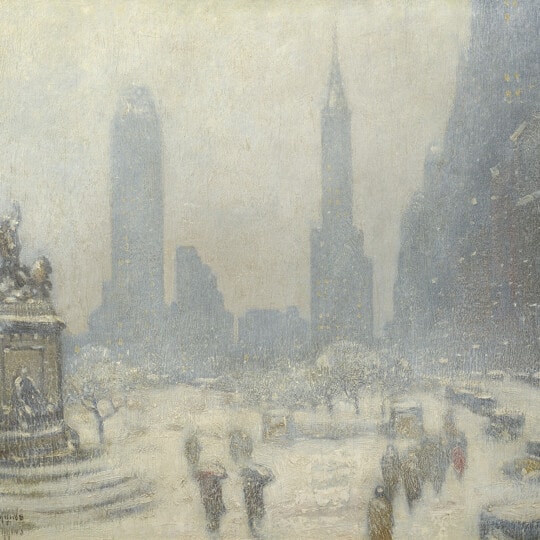
New York has always been my favorite subject, especially streets in snow storms.[1] —Guy C. Wiggins, 1948
By Nina Sangimino
I. Biography
II. Chronology
III. Collections
IV. Exhibitions
V. Memberships
VI. Notes
VII. Suggested Resources
I. Biography
Of the great family legacies in American art, Wiggins is definitely at the forefront. Carleton Wiggins studied with George Inness and painted landscapes with a Barbizon influence, and his grandson Guy A. Wiggins still paints both rural landscapes and urban city views. Yet the most well known of this clan is
New York has always been my favorite subject, especially streets in snow storms.[1] —Guy C. Wiggins, 1948
By Nina Sangimino
I. Biography
II. Chronology
III. Collections
IV. Exhibitions
V. Memberships
VI. Notes
VII. Suggested Resources
I. Biography
Of the great family legacies in American art, Wiggins is definitely at the forefront. Carleton Wiggins studied with George Inness and painted landscapes with a Barbizon influence, and his grandson Guy A. Wiggins still paints both rural landscapes and urban city views. Yet the most well known of this clan is Carleton’s son and Guy A.’s father, Guy Carleton Wiggins. Celebrated for his impressionist renderings of New York City, paintings by Guy C. Wiggins have maintained their popularity with collectors since Wiggins’s lifetime.
Born in Brooklyn in 1883, he spent his early childhood at St. Ives in Cornwall, England with his parents. He attended primary school in England and at a very young age painted watercolors in France and Holland. As early as 1890 his talent was recognized in the Brooklyn Eagle:
Carleton Wiggins has a talented son of school age who will be a worthy successor to his father if he amplifies the talent that is in him. At the age of 4, he began to draw and shortly after was making pictures in water color that are equal to not a few one sees in the exhibitions. It is a peculiarity of the youngster that, though self-educated, his themes are mature and his manner is strictly that of the adept water color painter…[2]
Wiggins was at that time learning his craft from his father and continued these informal lessons when the family returned to the United States and settled in Water Mill, New York in 1892.
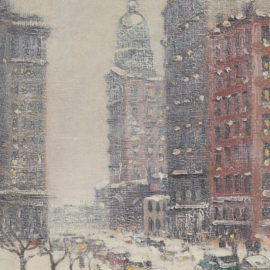
At the turn of the century, Wiggins entered the Polytechnic Institute in Brooklyn to study architecture, yet soon gave it up for art classes at the National Academy of Design where he studied with Ashcan leader Robert Henri. Henri encouraged his students to go out into the streets of Manhattan and look for their subjects in scenes of daily life in New York. Wiggins quickly took to cityscapes, and his art instruction paired with his previous training in architectural drawings led to a lifelong love of painting New York’s skyline and building facades. While his talent had been obvious since he was a child, his accomplishments were formally recognized in 1912 when The Metropolitan Museum of Art purchased his painting The Metropolitan Tower for inclusion in its collection.
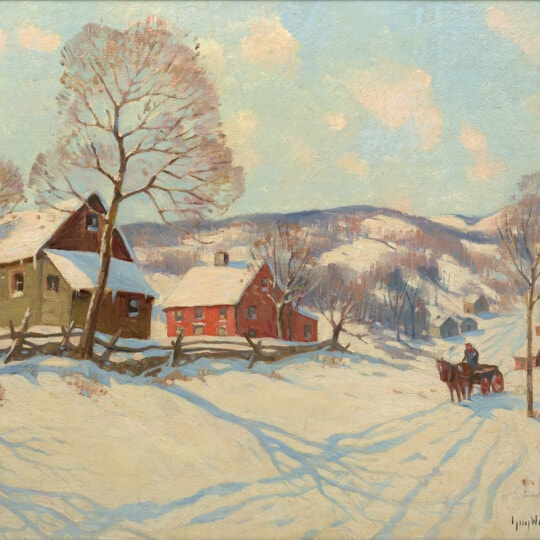
While Wiggins’s love of cityscapes was discovered in New York, his mastery of impressionism was achieved in Lyme, Connecticut. Carleton Wiggins had settled in Old Lyme in 1915 and was active in the Old Lyme art colony, the artist community where the American Barbizon movement began in 1900. Miss Florence Griswold famously hosted several important American artists at this mecca of plein-air painting, including impressionists such as Childe Hassam and John Henry Twachtman. In 1920, Guy Wiggins purchased a home in Lyme and began creating light-filled, rural scenes with a clear influence from the other artists working in the vicinity. Yet his style remained distinct and allowed him to maintain a crispness and solidity in his subjects, while at the same time exploring atmospheric effects. This would be the distinctive quality of his cityscapes that led to the great demand for his work.
Wiggins was devoted to Impressionism, yet in the mid-twenties briefly experimented with Modernism. He was commissioned by the Great Northern Railroad to paint scenes of the Rocky Mountains and spent a summer at Glacier National Park in Montana. As described by Anne Cohen DePietro, “He felt his signature impressionistic style was not adequate to capture the grandeur of the American West, and he ultimately turned to the more powerful, volumetric approach to painting that was almost Cézannesque in monumentality.”[3] Although Wiggins felt the need to expand his artistic vocabulary for this instance, he was always a commercially savvy artist and quickly returned to his best-selling impressionist works. As he once told his son Guy, “painting is a wonderful hobby, but a damned difficult way to make a living.”[4]
With the onset of the Depression in the 1930s, Wiggins had an especially “damned difficult” time selling paintings. He decided to leave New York for his home in Old Lyme where he founded the Guy Wiggins Art School. He became an important instructor, hosting guest teachers such as George Luks and Bruce Crane, and went on to travel across the United States giving demonstrations and workshops. In 1937 he relocated his school to Essex, Connecticut.
A prolific painter, Wiggins continued to create his preferred New York snow scenes for the rest of his life. He died in 1962 while on vacation in St. Augustine, Florida. His body was returned home to Connecticut and he is buried in Lyme. His work can be seen in several major museums, including The Art Institute of Chicago, Brooklyn Museum, and Smithsonian American Art Museum.
II. Chronology
1883 Born February 23 in Brooklyn, New York
1892 Moves to Water Mill, New York
1905 Visits Old Lyme, Connecticut for the first time hoping to visit with the American impressionists who have begun working there including Childe Hassam and Willard Leroy Metcalf
ca. 1907 Becomes a member of Salmagundi Club
1912 The Metropolitan Tower, 1912, is purchased by The Metropolitan Museum of Art
1914 Travels to St. Ives, England on commission to paint landscape for American patrons who later reneged on their agreement, returns after the outbreak of war with a new British wife
1916 Elected Associate member of the National Academy of Design
ca. 1918 Wiggins drops the middle initial “C” from his signature and begins signing his work as simply “Guy Wiggins”
1920 Buys a house in Lyme, Connecticut
ca. 1925 Receives a commission from The Great Northern Railroad to produce a series of paintings; spends the summer in Glacier National Park, Montana and creates his only modernist paintings
1927–1930s Serves as president of the Connecticut Academy of Fine Arts
1935 Elected Academician of the Connecticut Academy of Fine Arts
1936 Elected Academician of the National Academy of Design
Late 1930s–40s Maintains a studio in New York overlooking Washington Square Park, paints numerous views capturing every angle and season
1937–62 Lives in Essex, Connecticut and moves his art school there year round
1962 Dies April 25 in St. Augustine, Florida while on vacation; body returned to Old Lyme for burial
III. Collections
The Art Institute of Chicago, Illinois
Brooklyn Museum, New York
Dallas Museum of Art, Texas
The Heckscher Museum of Art, Huntington, New York
Hickory Museum of Art, North Carolina
Mattatuck Museum, Waterbury, Connecticut
The Metropolitan Museum of Art, New York, New York
New Britain Museum of American Art, Connecticut
Reading Public Museum, Pennsylvania
Richmond Art Museum, Indiana
The San Diego Museum of Art, Balboa Park, California
Smith College Museum of Art, Northampton, Massachusetts
Smithsonian American Art Museum, Washington, D.C.
The White House, Washington, D.C.
IV. Exhibitions
1908–23 Corcoran Gallery of Art, Washington, D.C., biennials, 5 times
1912–34 Pennsylvania Academy of the Fine Arts, Philadelphia, Pennsylvania, annuals, 9 times
1916 Salmagundi Club, New York, New York, prize
1919 Salmagundi Club, New York, New York, prize
1917 The Art Institute of Chicago, Illinois, Norman Wait Harris Bronze Medal
1916 Connecticut Academy of Fine Arts, Hartford, Connecticut, Hartford Prize
1918, 1931 Connecticut Academy of Fine Arts, Hartford, Connecticut, Flagg Prize
1922 Rhode Island School of Design, Providence, Rhode Island, J. Francis Murphy Memorial Prize
1926 Connecticut Academy of Fine Arts, Hartford, Connecticut, prizes
1929 New Rochelle Art Association, New York, prize
1930 New Haven Paint & Clay Club, Connecticut, prize
1933 Connecticut Academy of Fine Arts, Hartford, Connecticut, Athenaeum Prize
1938 Lotos Club, New York, New York, prize
1970 Campanile Galleries, Chicago, solo
1979 Loomis Chaffee School, Windsor, Connecticut; New Britain Museum of American Art, Connecticut, with Carleton and Guy A. Wiggins
1996 Lyme Academy of Fine Art, Old Lyme, Connecticut, with Carleton and Guy A. Wiggins
1998 Joan Whalen Fine Art, New York, New York, with Carleton and Guy A. Wiggins
V. Memberships
Connecticut Academy of Fine Arts, President, 1927–30s
Kit Kat Club
Lotos Club
Lyme Art Association
National Academy of Design, Associate, 1916; Academician, 1935
National Arts Club
New Haven Paint & Clay Club
Salmagundi Club, 1907
VI. Notes
Anne Cohen DePietro, The Salmagundi Club Celebrates Three Generations of Salmagundi Painters: J. Carleton Wiggins (1848–1932), Guy C. Wiggins (1883–1962), Guy A. Wiggins (1920–) (New York: Salmagundi Club, 2011), 14.
Ibid, 13.
Ibid, 15.
Harold Spencer, Susan G. Larkin, and Jeffrey W. Andersen, Connecticut and American Impressionism (Storrs, Connecticut: The William Benton Museum of Art, 1980), 178.
VII. Suggested Resources
DePietro, Anne Cohen. The Salmagundi Club Celebrates Three Generations of Salmagundi Painters: J. Carleton Wiggins (1848–1932), Guy C. Wiggins (1883–1962), Guy A. Wiggins (1920–). New York: Salmagundi Club, 2011.
Falk, Peter Hastings. Who Was Who in American Art, 1564–1975: 400 Years of Artists in America. Vol. III, P–Z. Madison, Connecticut: Sound View Press, 1999.
Guy C. Wiggins, American Impressionist. Chicago: Campanile Galleries, Inc., 1970.
Paintings by Three Generations of Wiggins, 1870s–1970s. New Britain, Connecticut: Loomis Chaffee School and New Britain Museum of Art, 1979.
Spencer, Harold, Susan G. Larkin, and Jeffrey W. Andersen. Connecticut and American Impressionism. Storrs, Connecticut: The William Benton Museum of Art, 1980.
Walt, Adrienne L. “Guy Wiggins: American Impressionist.” American Art Review 4 (Dec. 1977): 100–13.
Whalen, Joan. Wiggins, Wiggins, and Wiggins. New York: Joan Whalen Fine Art, 1998.
New York has always been my favorite subject, especially streets in snow storms.[1] —Guy C. Wiggins, 1948
By Nina Sangimino
I. Biography
II. Chronology
III. Collections
IV. Exhibitions
V. Memberships
VI. Notes
VII. Suggested Resources
I. Biography
Of the great family legacies in American art, Wiggins is definitely at the forefront. Carleton Wiggins studied with George Inness and painted landscapes with a Barbizon influence, and his grandson Guy A. Wiggins still paints both rural landscapes and urban city views. Yet the most well known of this clan is Carleton’s son and Guy A.’s father, Guy Carleton Wiggins. Celebrated for his impressionist renderings of New York City, paintings by Guy C. Wiggins have maintained their popularity with collectors since Wiggins’s lifetime.
Born in Brooklyn in 1883, he spent his early childhood at St. Ives in Cornwall, England with his parents. He attended primary school in England and at a very young age painted watercolors in France and Holland. As early as 1890 his talent was recognized in the Brooklyn Eagle:
Carleton Wiggins has a talented son of school age who will be a worthy successor to his father if he amplifies the talent that is in him. At the age of 4, he began to draw and shortly after was making pictures in water color that are equal to not a few one sees in the exhibitions. It is a peculiarity of the youngster that, though self-educated, his themes are mature and his manner is strictly that of the adept water color painter…[2]
Wiggins was at that time learning his craft from his father and continued these informal lessons when the family returned to the United States and settled in Water Mill, New York in 1892.
At the turn of the century, Wiggins entered the Polytechnic Institute in Brooklyn to study architecture, yet soon gave it up for art classes at the National Academy of Design where he studied with Ashcan leader Robert Henri. Henri encouraged his students to go out into the streets of Manhattan and look for their subjects in scenes of daily life in New York. Wiggins quickly took to cityscapes, and his art instruction paired with his previous training in architectural drawings led to a lifelong love of painting New York’s skyline and building facades. While his talent had been obvious since he was a child, his accomplishments were formally recognized in 1912 when The Metropolitan Museum of Art purchased his painting The Metropolitan Tower for inclusion in its collection.
While Wiggins’s love of cityscapes was discovered in New York, his mastery of impressionism was achieved in Lyme, Connecticut. Carleton Wiggins had settled in Old Lyme in 1915 and was active in the Old Lyme art colony, the artist community where the American Barbizon movement began in 1900. Miss Florence Griswold famously hosted several important American artists at this mecca of plein-air painting, including impressionists such as Childe Hassam and John Henry Twachtman. In 1920, Guy Wiggins purchased a home in Lyme and began creating light-filled, rural scenes with a clear influence from the other artists working in the vicinity. Yet his style remained distinct and allowed him to maintain a crispness and solidity in his subjects, while at the same time exploring atmospheric effects. This would be the distinctive quality of his cityscapes that led to the great demand for his work.
Wiggins was devoted to Impressionism, yet in the mid-twenties briefly experimented with Modernism. He was commissioned by the Great Northern Railroad to paint scenes of the Rocky Mountains and spent a summer at Glacier National Park in Montana. As described by Anne Cohen DePietro, “He felt his signature impressionistic style was not adequate to capture the grandeur of the American West, and he ultimately turned to the more powerful, volumetric approach to painting that was almost Cézannesque in monumentality.”[3] Although Wiggins felt the need to expand his artistic vocabulary for this instance, he was always a commercially savvy artist and quickly returned to his best-selling impressionist works. As he once told his son Guy, “painting is a wonderful hobby, but a damned difficult way to make a living.”[4]
With the onset of the Depression in the 1930s, Wiggins had an especially “damned difficult” time selling paintings. He decided to leave New York for his home in Old Lyme where he founded the Guy Wiggins Art School. He became an important instructor, hosting guest teachers such as George Luks and Bruce Crane, and went on to travel across the United States giving demonstrations and workshops. In 1937 he relocated his school to Essex, Connecticut.
A prolific painter, Wiggins continued to create his preferred New York snow scenes for the rest of his life. He died in 1962 while on vacation in St. Augustine, Florida. His body was returned home to Connecticut and he is buried in Lyme. His work can be seen in several major museums, including The Art Institute of Chicago, Brooklyn Museum, and Smithsonian American Art Museum.
II. Chronology
1883 Born February 23 in Brooklyn, New York
1892 Moves to Water Mill, New York
1905 Visits Old Lyme, Connecticut for the first time hoping to visit with the American impressionists who have begun working there including Childe Hassam and Willard Leroy Metcalf
ca. 1907 Becomes a member of Salmagundi Club
1912 The Metropolitan Tower, 1912, is purchased by The Metropolitan Museum of Art
1914 Travels to St. Ives, England on commission to paint landscape for American patrons who later reneged on their agreement, returns after the outbreak of war with a new British wife
1916 Elected Associate member of the National Academy of Design
ca. 1918 Wiggins drops the middle initial “C” from his signature and begins signing his work as simply “Guy Wiggins”
1920 Buys a house in Lyme, Connecticut
ca. 1925 Receives a commission from The Great Northern Railroad to produce a series of paintings; spends the summer in Glacier National Park, Montana and creates his only modernist paintings
1927–1930s Serves as president of the Connecticut Academy of Fine Arts
1935 Elected Academician of the Connecticut Academy of Fine Arts
1936 Elected Academician of the National Academy of Design
Late 1930s–40s Maintains a studio in New York overlooking Washington Square Park, paints numerous views capturing every angle and season
1937–62 Lives in Essex, Connecticut and moves his art school there year round
1962 Dies April 25 in St. Augustine, Florida while on vacation; body returned to Old Lyme for burial
III. Collections
The Art Institute of Chicago, Illinois
Brooklyn Museum, New York
Dallas Museum of Art, Texas
The Heckscher Museum of Art, Huntington, New York
Hickory Museum of Art, North Carolina
Mattatuck Museum, Waterbury, Connecticut
The Metropolitan Museum of Art, New York, New York
New Britain Museum of American Art, Connecticut
Reading Public Museum, Pennsylvania
Richmond Art Museum, Indiana
The San Diego Museum of Art, Balboa Park, California
Smith College Museum of Art, Northampton, Massachusetts
Smithsonian American Art Museum, Washington, D.C.
The White House, Washington, D.C.
IV. Exhibitions
1908–23 Corcoran Gallery of Art, Washington, D.C., biennials, 5 times
1912–34 Pennsylvania Academy of the Fine Arts, Philadelphia, Pennsylvania, annuals, 9 times
1916 Salmagundi Club, New York, New York, prize
1919 Salmagundi Club, New York, New York, prize
1917 The Art Institute of Chicago, Illinois, Norman Wait Harris Bronze Medal
1916 Connecticut Academy of Fine Arts, Hartford, Connecticut, Hartford Prize
1918, 1931 Connecticut Academy of Fine Arts, Hartford, Connecticut, Flagg Prize
1922 Rhode Island School of Design, Providence, Rhode Island, J. Francis Murphy Memorial Prize
1926 Connecticut Academy of Fine Arts, Hartford, Connecticut, prizes
1929 New Rochelle Art Association, New York, prize
1930 New Haven Paint & Clay Club, Connecticut, prize
1933 Connecticut Academy of Fine Arts, Hartford, Connecticut, Athenaeum Prize
1938 Lotos Club, New York, New York, prize
1970 Campanile Galleries, Chicago, solo
1979 Loomis Chaffee School, Windsor, Connecticut; New Britain Museum of American Art, Connecticut, with Carleton and Guy A. Wiggins
1996 Lyme Academy of Fine Art, Old Lyme, Connecticut, with Carleton and Guy A. Wiggins
1998 Joan Whalen Fine Art, New York, New York, with Carleton and Guy A. Wiggins
V. Memberships
Connecticut Academy of Fine Arts, President, 1927–30s
Kit Kat Club
Lotos Club
Lyme Art Association
National Academy of Design, Associate, 1916; Academician, 1935
National Arts Club
New Haven Paint & Clay Club
Salmagundi Club, 1907
VI. Notes
Anne Cohen DePietro, The Salmagundi Club Celebrates Three Generations of Salmagundi Painters: J. Carleton Wiggins (1848–1932), Guy C. Wiggins (1883–1962), Guy A. Wiggins (1920–) (New York: Salmagundi Club, 2011), 14.
Ibid, 13.
Ibid, 15.
Harold Spencer, Susan G. Larkin, and Jeffrey W. Andersen, Connecticut and American Impressionism (Storrs, Connecticut: The William Benton Museum of Art, 1980), 178.
VII. Suggested Resources
DePietro, Anne Cohen. The Salmagundi Club Celebrates Three Generations of Salmagundi Painters: J. Carleton Wiggins (1848–1932), Guy C. Wiggins (1883–1962), Guy A. Wiggins (1920–). New York: Salmagundi Club, 2011.
Falk, Peter Hastings. Who Was Who in American Art, 1564–1975: 400 Years of Artists in America. Vol. III, P–Z. Madison, Connecticut: Sound View Press, 1999.
Guy C. Wiggins, American Impressionist. Chicago: Campanile Galleries, Inc., 1970.
Paintings by Three Generations of Wiggins, 1870s–1970s. New Britain, Connecticut: Loomis Chaffee School and New Britain Museum of Art, 1979.
Spencer, Harold, Susan G. Larkin, and Jeffrey W. Andersen. Connecticut and American Impressionism. Storrs, Connecticut: The William Benton Museum of Art, 1980.
Walt, Adrienne L. “Guy Wiggins: American Impressionist.” American Art Review 4 (Dec. 1977): 100–13.
Whalen, Joan. Wiggins, Wiggins, and Wiggins. New York: Joan Whalen Fine Art, 1998.