Artist Biography
Daniel Folger Bigelow
(1823 - 1910)
Daniel Folger Bigelow was born in 1823 on a farm in Lake Champlain Valley, New York, into a prosperous Quaker family. Surrounded by the lake, the Adirondacks, and Vermont’s Green Mountains, he developed a love for color and nature. Encouraged by his parents, he showed talent for drawing though they doubted it could lead to a career. His first formal training came in 1841 with itinerant painter Asahel Lynde Powers, who taught him color and oil technique. Bigelow supported his pursuit of art by working in marble quarries and saved enough to travel to New York City, where he studied paintings by leading Hudson River School artists. By the late 1850s, he moved to Chicago, where he painted portraits, taught, and joined the city’s growing art community.
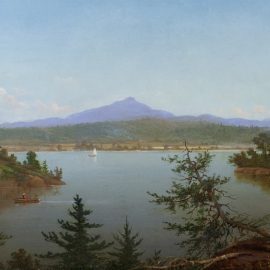
Bigelow’s landscapes of Lake Champlain and the Adirondacks became his signature, praised for their realism, poetic tone, and devotion to nature. He exhibited widely, including at the Inter-State Industrial Expositions, the Art Institute of Chicago, the Pennsylvania Academy of the Fine Arts, and the National Academy of Design. His work also appeared at the Union League Club, the Chicago Historical Society, and the Illinois State Historical Library–institutions that later acquired his paintings. By the 1880s and 1890s, his paintings hung alongside those of George Inness, William Merritt Chase, and even Impressionists such as Monet and Renoir.