Artist Biography
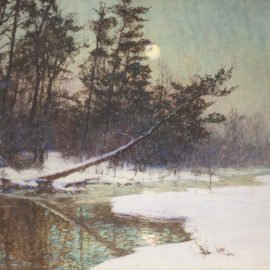
An important nineteenth-century American artist widely celebrated for his incandescent snow scenes and depictions of Venice, Italy.
By Chelsea DeLay
I. Biography
II. Chronology
III. Collections
IV. Exhibitions
V. Memberships
VI. Notes
VII. Suggested Resources
I. Biography
The son of sculptor Erastus Dow Palmer, Walter Launt Palmer was born in 1854 in Albany, New York. During his youth, he was immersed in a steady stream of artists visiting the Palmer family home and spent time in the presence of Frederic Edwin Church, John Frederick Kensett, and Jervis
An important nineteenth-century American artist widely celebrated for his incandescent snow scenes and depictions of Venice, Italy.
By Chelsea DeLay
I. Biography
II. Chronology
III. Collections
IV. Exhibitions
V. Memberships
VI. Notes
VII. Suggested Resources
I. Biography
The son of sculptor Erastus Dow Palmer, Walter Launt Palmer was born in 1854 in Albany, New York. During his youth, he was immersed in a steady stream of artists visiting the Palmer family home and spent time in the presence of Frederic Edwin Church, John Frederick Kensett, and Jervis McEntee. At the age of sixteen, Palmer developed an early interest in painting led him to pursue formal training under the instruction of Church; after one year, Church remarked, “…Wallie is the coming man so far as I can see and I would like to be of use to him before he gets so far advanced as to not require my aid.”(1) Palmer’s rapid progress as a painter was confirmed in 1872 when his submission to the National Academy of Design, Mountain Pastures, was accepted for exhibition.
During a trip abroad with his family in 1873, Palmer visited the studios of expatriate artists throughout Italy and France, including John Singer Sargent. It was during this trip that Palmer first visited Venice—he was captivated by the glimmering canal waters and Italian architecture, which were subjects he repeatedly returned to throughout his career. While in France, Palmer enrolled at the atelier of French portrait painter Emile Auguste Carolus-Duran, which he later returned to resume his studies in 1877. The influence of Carolus-Duran’s teachings is seen in the tight, academic style of Palmer’s early work. When he returned to New York City, Palmer rented a studio in the famous West Tenth Street studio building, which he was sharing with Church by 1878. It was around this time that Palmer began painting interior scenes; however, his concentrated attention to detail—a quality that earned high praise from critics—caused significant strain on Palmer’s already poor eyesight. Suffering from a severely crossed eye since his youth, Palmer made the decision to surgically correct the condition in 1879.(2)
He frequently attended events of New York City’s art world, taking in theater performances and attending, and hosting, studio parties, where he became friends with William Merritt Chase and Jervis McEntee. After Palmer and Church gave up their studio in 1881, Palmer left New York City and went abroad again, passing two months painting in Venice and spending the remainder of his time in Europe in the company of John Henry Twachtman, Robert Frederick Blum, Frank Duveneck, and Chase. During this trip, the work he created demonstrated a newfound use of rich colors and tones; he exhibited three Venetian scenes at the National Academy in 1886, which favorably reviewed:
Palmer belongs in the ranks of the American impressionists. His pictures are distinguished by purity and truth of color…especially true of his landscapes and his Venetian lagune[sic] subjects…He sees nature without the help of the conventional resources of art.(3)
Palmer’s work was frequently exhibited throughout the 1880s and won awards at the Boston Art Club, National Academy of Design, and American Water Color Society. He received the Hallgarten prize in 1887 for January—his technique of rendering the snow using blue had never before been seen and was commended by critics. In the midst of his rising success, he married Georgianna Myers in 1890, who tragically died during childbirth only two years later. He continued to work throughout his grief, painting winter and Venetian scenes that bolstered his artistic fame well into the late-1890s, and he became a member of several prominent artist organizations, including the New York Water Color Club and Society of American Landscape Painters; he was also elected Academician of the National Academy in 1897.
The year 1895 was an important one in Palmer’s career: in January, he went on a sketching trip in Mexico with Church, was married for second time to wife Zoe de Vautrin, and received the prestigious W. T. Evans prize from the American Water Color Society of New York. The awarded work, The Vale of Tawasentha, was praised for “…the dazzling effects of sunlight on snow, the bare branches silhouetted against the gray and gold light…the picture is clear, clever, correct, without an ounce of sentiment.”(4) His work continued to be shown after the turn of the century and was exhibited at the Philadelphia Art Club, Pan-American Exposition, Society of American Artists, and St. Louis Exhibition.
Palmer’s successful career was recognized in his appointment to serve on the New York Fine Arts Federation in 1924, and he was also celebrated at the National Academy’s Centennial Exhibition in 1925. He passed away in his home in Albany, New York, after suffering a fatal case of pneumonia in April of 1932. Renowned for his exquisitely beautiful snow scenes and depictions of Venice, Palmer’s work can today be seen in the permanent collections of The Metropolitan Museum of Art, New York, New York; Museum of Fine Arts, Boston, Massachusetts; and the Smithsonian American Art Museum, Washington, D.C.
II. Chronology
1854 Born August 1 to Erastus Dow Palmer and Mary Seaman Palmer
1870 Studies with Frederic Edwin Church; attends the Albany Boys School
1872 Mountain Pasture is his first work accepted by the National Academy of Design for exhibition
1873 Travels abroad with several family members, they visit numerous studios of expatriate artists throughout Italy and France; meets John Singer Sargent in Florence
1874 Enrolls in the Parisian studio of Carolus-Duran in January, returns home in June
1877 Returns to France and resumes studies at Carolus-Duran’s studio
1878 Opens studio with Church at the West Fourth Street Studio Building in New York City
1879 Has corrective eye surgery to improve sight
1881 Closes West Fourth Street studio; travels abroad and spends two months in Venice; elected member of the Society of American Artists
1884 Exhibits two autumn scenes at the inaugural “Painters in Pastel” exhibition
1890 Marries Georgianna Myers
1892 Wife Georgianna dies July 9, infant Jessie dies July 10
1894 Scribner’s Monthly publishes his science-fiction story, The Mantle of Osiris
1895 Goes to Mexico with Church from January through February; receives W. T. Evans prize from the American Water Color Society of New York for Vale of Tawasentha; marries Zoe de Vautrin Wyndham in December
1897 Travels to Canada and Alaska with wife Zoe; elected Academician at the National Academy
1898 Joins the Society of American Landscape Painters
1899 Travels to Japan with wife Zoe and noted Canadian collector Sir William Van Horne, visits Yokohama, Tokyo, Kobe, Nagasaki, Nagoya, Kyoto, stays briefly in Hong Kong, Canton, and Macao
1903 Daughter Beatrice is born in Albany, New York
1908 Attends a dinner at the White House with Zoe as guests of the President of the United States, Theodore Roosevelt
1921 The Metropolitan Museum of Art acquires Silent Dawn
1924 Appointed to the New York State Fine Arts Commission
1925 Recognized at the National Academy’s Centennial Exhibition
1932 Dies in Albany, New York
III. Collections
Albany Institute of History & Art, New York
The Arkell Museum at Canajoharie, New York
Memorial Art Gallery of the University of Rochester, New York
The Metropolitan Museum of Art, New York, New York
Museum of Fine Arts, Boston, Massachusetts
Public Gallery, Richmond, Indiana
Smithsonian American Art Museum, Washington, D.C.
IV. Exhibitions
1872, 1875, 1876, 1878–80, 1882–1932 National Academy of Design, New York, New York
1880 Union League Club, New York, New York
1881, 1884–86 Brooklyn Art Association, New York
1882–1928 Pennsylvania Academy of the Fine Arts, Philadelphia, Pennsylvania
1884–5 American Water Color Society, New York, New York, Evans prize
1885–86, 1888–89, 1893, 1895–98 Boston Art Club, Massachusetts, gold medal, 1895
1872–1930 National Academy of Design, New York, New York, 1887, Hallgarten prize
1893 Columbian Exposition, Chicago, Illinois, medal
1894 Philadelphia Art Club, Pennsylvania, gold medal
1895 American Water Color Society, New York, New York, W. T. Evans prize
1897 Tennessee Centennial Exposition, Nashville, Tennessee, silver medal
1899–1900 Society of Landscape Painters, New York, New York
1899 Avery Gallery, New York, New York, solo exhibition
1900 Paris Exposition, France, Honorable Mention
1901 Pan-American Exposition, Buffalo, New York, silver medal
1902 Charleston Exposition, South Carolina, second prize
1903 Baltimore Water Color, Maryland
1903–4 Noe Gallery, New York, New York, solo exhibitions
1904 St. Louis Exposition, Missouri, silver medal, bronze medal
1907 Philadelphia Art Club, Pennsylvania, silver medal
1908, 1910, 1912 Corocoran Gallery of Art, Washington, D.C., biennials, four times
1910 Buenos Aires Exposition, Argentina, bronze medal
1919 The Art Institute of Chicago, Illinois, Butler prize
1926, 1928 Wilmington, Delaware, 1926, Du Pont prize; 1928, 1st and 2nd Du Pont prize
2007 Albany Institute of History & Art, New York, solo exhibition
V. Memberships
American Federation of Arts
American Watercolor Society
Century Association
National Academy of Design, Associate, 1887, Academician, 1897
New York Water Color Club, 1890
New York State Fine Arts Commission, 1926
Society of American Artists, 1881
Society of American Landscape Painters, 1898
Society of Painters in Pastel, 1890
Salmagundi Club, 1901
Sociéte Internationale des Beaux-Arts et des Lettres
VI. Notes
1. Maybelle Mann, Walter Launt Palmer: Poetic Reality (Exton, Pennsylvania: Shiffer Publishing Limited, 1884), 12.
2. Ibid., 20.
3. J. S. King, “Painter & Sculptors: Walter L. Palmer,” Art Age IV (August 1886), n.p.
4. Mann, 61.
VII. Suggested Resources
Falk, Peter Hastings, ed. Who Was Who in American Art, 1564–1975: 400 Years of Artists in America, vol. I: A–F. Madison, Connecticut: Sound View Press, 1999.
King, J. S. “Painter & Sculptors: Walter L. Palmer,” in Art Age IV (August 1886).
Mann, Maybelle. Walter Launt Palmer: Poetic Reality. Exton: Shiffer Publishing Limited, 1884.
An important nineteenth-century American artist widely celebrated for his incandescent snow scenes and depictions of Venice, Italy.
By Chelsea DeLay
I. Biography
II. Chronology
III. Collections
IV. Exhibitions
V. Memberships
VI. Notes
VII. Suggested Resources
I. Biography
The son of sculptor Erastus Dow Palmer, Walter Launt Palmer was born in 1854 in Albany, New York. During his youth, he was immersed in a steady stream of artists visiting the Palmer family home and spent time in the presence of Frederic Edwin Church, John Frederick Kensett, and Jervis McEntee. At the age of sixteen, Palmer developed an early interest in painting led him to pursue formal training under the instruction of Church; after one year, Church remarked, “…Wallie is the coming man so far as I can see and I would like to be of use to him before he gets so far advanced as to not require my aid.”(1) Palmer’s rapid progress as a painter was confirmed in 1872 when his submission to the National Academy of Design, Mountain Pastures, was accepted for exhibition.
During a trip abroad with his family in 1873, Palmer visited the studios of expatriate artists throughout Italy and France, including John Singer Sargent. It was during this trip that Palmer first visited Venice—he was captivated by the glimmering canal waters and Italian architecture, which were subjects he repeatedly returned to throughout his career. While in France, Palmer enrolled at the atelier of French portrait painter Emile Auguste Carolus-Duran, which he later returned to resume his studies in 1877. The influence of Carolus-Duran’s teachings is seen in the tight, academic style of Palmer’s early work. When he returned to New York City, Palmer rented a studio in the famous West Tenth Street studio building, which he was sharing with Church by 1878. It was around this time that Palmer began painting interior scenes; however, his concentrated attention to detail—a quality that earned high praise from critics—caused significant strain on Palmer’s already poor eyesight. Suffering from a severely crossed eye since his youth, Palmer made the decision to surgically correct the condition in 1879.(2)
He frequently attended events of New York City’s art world, taking in theater performances and attending, and hosting, studio parties, where he became friends with William Merritt Chase and Jervis McEntee. After Palmer and Church gave up their studio in 1881, Palmer left New York City and went abroad again, passing two months painting in Venice and spending the remainder of his time in Europe in the company of John Henry Twachtman, Robert Frederick Blum, Frank Duveneck, and Chase. During this trip, the work he created demonstrated a newfound use of rich colors and tones; he exhibited three Venetian scenes at the National Academy in 1886, which favorably reviewed:
Palmer belongs in the ranks of the American impressionists. His pictures are distinguished by purity and truth of color…especially true of his landscapes and his Venetian lagune[sic] subjects…He sees nature without the help of the conventional resources of art.(3)
Palmer’s work was frequently exhibited throughout the 1880s and won awards at the Boston Art Club, National Academy of Design, and American Water Color Society. He received the Hallgarten prize in 1887 for January—his technique of rendering the snow using blue had never before been seen and was commended by critics. In the midst of his rising success, he married Georgianna Myers in 1890, who tragically died during childbirth only two years later. He continued to work throughout his grief, painting winter and Venetian scenes that bolstered his artistic fame well into the late-1890s, and he became a member of several prominent artist organizations, including the New York Water Color Club and Society of American Landscape Painters; he was also elected Academician of the National Academy in 1897.
The year 1895 was an important one in Palmer’s career: in January, he went on a sketching trip in Mexico with Church, was married for second time to wife Zoe de Vautrin, and received the prestigious W. T. Evans prize from the American Water Color Society of New York. The awarded work, The Vale of Tawasentha, was praised for “…the dazzling effects of sunlight on snow, the bare branches silhouetted against the gray and gold light…the picture is clear, clever, correct, without an ounce of sentiment.”(4) His work continued to be shown after the turn of the century and was exhibited at the Philadelphia Art Club, Pan-American Exposition, Society of American Artists, and St. Louis Exhibition.
Palmer’s successful career was recognized in his appointment to serve on the New York Fine Arts Federation in 1924, and he was also celebrated at the National Academy’s Centennial Exhibition in 1925. He passed away in his home in Albany, New York, after suffering a fatal case of pneumonia in April of 1932. Renowned for his exquisitely beautiful snow scenes and depictions of Venice, Palmer’s work can today be seen in the permanent collections of The Metropolitan Museum of Art, New York, New York; Museum of Fine Arts, Boston, Massachusetts; and the Smithsonian American Art Museum, Washington, D.C.
II. Chronology
1854 Born August 1 to Erastus Dow Palmer and Mary Seaman Palmer
1870 Studies with Frederic Edwin Church; attends the Albany Boys School
1872 Mountain Pasture is his first work accepted by the National Academy of Design for exhibition
1873 Travels abroad with several family members, they visit numerous studios of expatriate artists throughout Italy and France; meets John Singer Sargent in Florence
1874 Enrolls in the Parisian studio of Carolus-Duran in January, returns home in June
1877 Returns to France and resumes studies at Carolus-Duran’s studio
1878 Opens studio with Church at the West Fourth Street Studio Building in New York City
1879 Has corrective eye surgery to improve sight
1881 Closes West Fourth Street studio; travels abroad and spends two months in Venice; elected member of the Society of American Artists
1884 Exhibits two autumn scenes at the inaugural “Painters in Pastel” exhibition
1890 Marries Georgianna Myers
1892 Wife Georgianna dies July 9, infant Jessie dies July 10
1894 Scribner’s Monthly publishes his science-fiction story, The Mantle of Osiris
1895 Goes to Mexico with Church from January through February; receives W. T. Evans prize from the American Water Color Society of New York for Vale of Tawasentha; marries Zoe de Vautrin Wyndham in December
1897 Travels to Canada and Alaska with wife Zoe; elected Academician at the National Academy
1898 Joins the Society of American Landscape Painters
1899 Travels to Japan with wife Zoe and noted Canadian collector Sir William Van Horne, visits Yokohama, Tokyo, Kobe, Nagasaki, Nagoya, Kyoto, stays briefly in Hong Kong, Canton, and Macao
1903 Daughter Beatrice is born in Albany, New York
1908 Attends a dinner at the White House with Zoe as guests of the President of the United States, Theodore Roosevelt
1921 The Metropolitan Museum of Art acquires Silent Dawn
1924 Appointed to the New York State Fine Arts Commission
1925 Recognized at the National Academy’s Centennial Exhibition
1932 Dies in Albany, New York
III. Collections
Albany Institute of History & Art, New York
The Arkell Museum at Canajoharie, New York
Memorial Art Gallery of the University of Rochester, New York
The Metropolitan Museum of Art, New York, New York
Museum of Fine Arts, Boston, Massachusetts
Public Gallery, Richmond, Indiana
Smithsonian American Art Museum, Washington, D.C.
IV. Exhibitions
1872, 1875, 1876, 1878–80, 1882–1932 National Academy of Design, New York, New York
1880 Union League Club, New York, New York
1881, 1884–86 Brooklyn Art Association, New York
1882–1928 Pennsylvania Academy of the Fine Arts, Philadelphia, Pennsylvania
1884–5 American Water Color Society, New York, New York, Evans prize
1885–86, 1888–89, 1893, 1895–98 Boston Art Club, Massachusetts, gold medal, 1895
1872–1930 National Academy of Design, New York, New York, 1887, Hallgarten prize
1893 Columbian Exposition, Chicago, Illinois, medal
1894 Philadelphia Art Club, Pennsylvania, gold medal
1895 American Water Color Society, New York, New York, W. T. Evans prize
1897 Tennessee Centennial Exposition, Nashville, Tennessee, silver medal
1899–1900 Society of Landscape Painters, New York, New York
1899 Avery Gallery, New York, New York, solo exhibition
1900 Paris Exposition, France, Honorable Mention
1901 Pan-American Exposition, Buffalo, New York, silver medal
1902 Charleston Exposition, South Carolina, second prize
1903 Baltimore Water Color, Maryland
1903–4 Noe Gallery, New York, New York, solo exhibitions
1904 St. Louis Exposition, Missouri, silver medal, bronze medal
1907 Philadelphia Art Club, Pennsylvania, silver medal
1908, 1910, 1912 Corocoran Gallery of Art, Washington, D.C., biennials, four times
1910 Buenos Aires Exposition, Argentina, bronze medal
1919 The Art Institute of Chicago, Illinois, Butler prize
1926, 1928 Wilmington, Delaware, 1926, Du Pont prize; 1928, 1st and 2nd Du Pont prize
2007 Albany Institute of History & Art, New York, solo exhibition
V. Memberships
American Federation of Arts
American Watercolor Society
Century Association
National Academy of Design, Associate, 1887, Academician, 1897
New York Water Color Club, 1890
New York State Fine Arts Commission, 1926
Society of American Artists, 1881
Society of American Landscape Painters, 1898
Society of Painters in Pastel, 1890
Salmagundi Club, 1901
Sociéte Internationale des Beaux-Arts et des Lettres
VI. Notes
1. Maybelle Mann, Walter Launt Palmer: Poetic Reality (Exton, Pennsylvania: Shiffer Publishing Limited, 1884), 12.
2. Ibid., 20.
3. J. S. King, “Painter & Sculptors: Walter L. Palmer,” Art Age IV (August 1886), n.p.
4. Mann, 61.
VII. Suggested Resources
Falk, Peter Hastings, ed. Who Was Who in American Art, 1564–1975: 400 Years of Artists in America, vol. I: A–F. Madison, Connecticut: Sound View Press, 1999.
King, J. S. “Painter & Sculptors: Walter L. Palmer,” in Art Age IV (August 1886).
Mann, Maybelle. Walter Launt Palmer: Poetic Reality. Exton: Shiffer Publishing Limited, 1884.