Artist Biography
Theodore Wendel
(1859 - 1932)
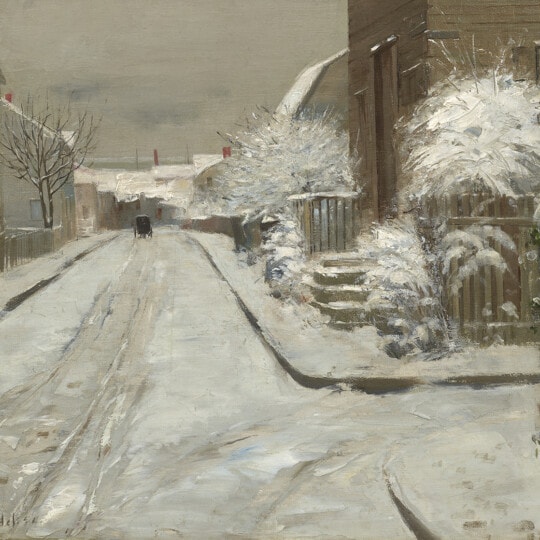
Theodore Wendel was born in Midway, Ohio, where his father, a German immigrant, ran a general store. At fifteen he briefly joined the circus as an acrobat before turning to art, studying in Cincinnati with Frank Duveneck. In 1878 he followed Duveneck to Munich and studied at the Royal Academy, though he and fellow Midwestern painters such as Joseph DeCamp preferred a more radical approach characterized by direct, unmodulated brushwork and dramatic contrasts of light and dark.[1] He worked in Munich, Venice, and Florence until 1882, then returned to the United States to paint in New York, Boston, Newport, and Cincinnati.
In 1886 Wendel entered the Académie Julian in Paris and spent the summers of 1887 and 1888 in Giverny, where he was among the first Americans to pioneer Impressionism—winning praise from Monet himself. Back in Boston, his 1889 exhibition of French landscapes was celebrated for its brilliant color and purple-blue shadows. He later taught at Wellesley College and the Cowles Art School while painting in Newport, Cape Ann, and Gloucester.
Wendel married in 1897 and toured Europe before settling on a farm in Ipswich, Massachusetts, whose rural scenery inspired some of his finest work. Although a fire destroyed much of his early output, he remained a leading Boston Impressionist, earning numerous prizes, including a silver medal at the 1915 Panama-Pacific Exposition, and was honored that year with a solo exhibition by the Guild of Boston Artists. Wendel’s work is represented in collections internationally, including the Museum of Fine Arts, Boston; the Pennsylvania Academy of the Fine Arts; and the Musée des Impressionnismes Giverny, among others.
[1] Buckley, Laurene, and William H. Gerdts. 2019. Theodore Wendel: True Notes of American Impressionism. First edition. North Adams, MA: The Artist Book Foundation.