Artist Biography
Following in the tradition of numerous American artists, Richard Edward Miller spent the majority of his career abroad. Miller studied art in his hometown of St. Louis, Missouri for a number of years before moving to France in 1898, where he earned a scholarship at the famous Académie Julian. Here, Miller’s work met with great approval; the artist submitted work to the Paris salon numerous times, winning medals of award in 1900 and 1904. Miller also devoted his time to the education of young artists, teaching at the Colarossi Art School in Paris and leading classes for
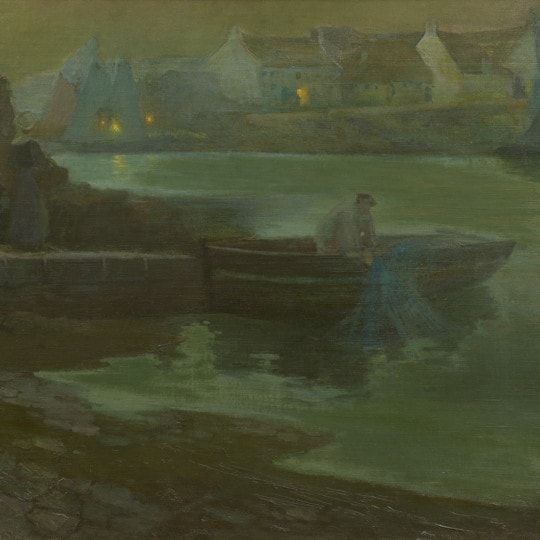
Following in the tradition of numerous American artists, Richard Edward Miller spent the majority of his career abroad. Miller studied art in his hometown of St. Louis, Missouri for a number of years before moving to France in 1898, where he earned a scholarship at the famous Académie Julian. Here, Miller’s work met with great approval; the artist submitted work to the Paris salon numerous times, winning medals of award in 1900 and 1904. Miller also devoted his time to the education of young artists, teaching at the Colarossi Art School in Paris and leading classes for American and French art students in Giverny and Brittany. Although Miller was renowned for his paintings before the 1900’s, it was not until this period that the artist fully explored Impressionism. During the years leading to World War I, Miller studied the private conversations and human connections found in Parisian cafes and along city boulevards. The artist transformed these scenes into what he called “pleasant optical sensation[s],” in which the narrative element of the composition was second to the decorative application of paint and sensitive modulation of tones. Miller eventually returned to the United States before World War I, living in Pasadena, California, Providence, Massachusetts, and St. Augustine, Florida. The artist’s influential work and teachings after his return from Europe forms part of William H. Gerdts and Will South’s recent 1998 publication “California Impressionism.” Miller’s works can be viewed in both the United States and Europe at the Metropolitan Museum of Art in New York, the Art Institute of Chicago and the Luxembourg, Paris.
Selected Bibliography:
Earle, Helen L. “Biographical Sketches of American Artists.” 5th ed. New Jersey: Anthony C. Schmidt Fine Arts, 1972.
Falk, Peter Hastings, ed.. “Who Was Who in American Art 1564-1975: 400 Years of Artists in America.” Madison, CT: Sound View Press, 1999.
Preato, Robert R and Langer, Sandra L. “Impressionism and Post-Impressionism, Transformations in the Modern American Mode 1885-1945.” New York: Grand Central Art Galleries, Inc., 1988.
Following in the tradition of numerous American artists, Richard Edward Miller spent the majority of his career abroad. Miller studied art in his hometown of St. Louis, Missouri for a number of years before moving to France in 1898, where he earned a scholarship at the famous Académie Julian. Here, Miller’s work met with great approval; the artist submitted work to the Paris salon numerous times, winning medals of award in 1900 and 1904. Miller also devoted his time to the education of young artists, teaching at the Colarossi Art School in Paris and leading classes for American and French art students in Giverny and Brittany. Although Miller was renowned for his paintings before the 1900’s, it was not until this period that the artist fully explored Impressionism. During the years leading to World War I, Miller studied the private conversations and human connections found in Parisian cafes and along city boulevards. The artist transformed these scenes into what he called “pleasant optical sensation[s],” in which the narrative element of the composition was second to the decorative application of paint and sensitive modulation of tones. Miller eventually returned to the United States before World War I, living in Pasadena, California, Providence, Massachusetts, and St. Augustine, Florida. The artist’s influential work and teachings after his return from Europe forms part of William H. Gerdts and Will South’s recent 1998 publication “California Impressionism.” Miller’s works can be viewed in both the United States and Europe at the Metropolitan Museum of Art in New York, the Art Institute of Chicago and the Luxembourg, Paris.
Selected Bibliography:
Earle, Helen L. “Biographical Sketches of American Artists.” 5th ed. New Jersey: Anthony C. Schmidt Fine Arts, 1972.
Falk, Peter Hastings, ed.. “Who Was Who in American Art 1564-1975: 400 Years of Artists in America.” Madison, CT: Sound View Press, 1999.
Preato, Robert R and Langer, Sandra L. “Impressionism and Post-Impressionism, Transformations in the Modern American Mode 1885-1945.” New York: Grand Central Art Galleries, Inc., 1988.