Artist Biography
Famous American Sporting Artist and a “Good Academician”[1]
By Amy Spencer
Ogden Pleissner was a realist artist whose passion for the outdoors translated as a powerful emotional presence in his paintings.
I. Biography
II. Chronology
III. Collections
IV. Exhibitions
V. Memberships
VI. Notes
VII. Suggested Resources
I. Biography
Ogden Minton Pleissner was a twentieth century artist whose traditional images of city scenes, landscapes, battle fields, and sporting subjects were realistically detailed, yet uniquely evocative. He had some academic art training; however, Pleissner always credited his painting skills to
Famous American Sporting Artist and a “Good Academician”[1]
By Amy Spencer
Ogden Pleissner was a realist artist whose passion for the outdoors translated as a powerful emotional presence in his paintings.
I. Biography
II. Chronology
III. Collections
IV. Exhibitions
V. Memberships
VI. Notes
VII. Suggested Resources
I. Biography
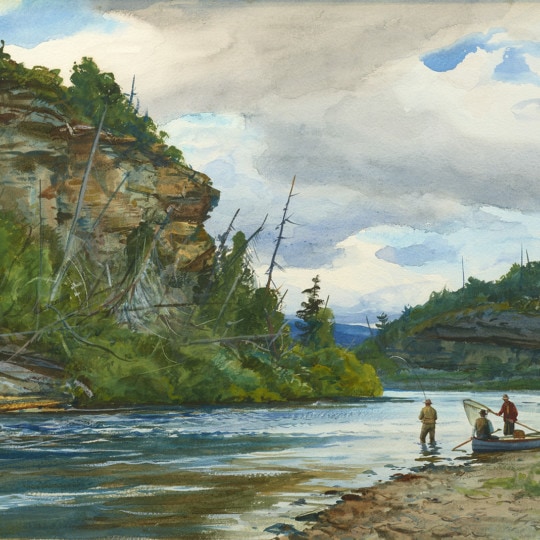
Ogden Minton Pleissner was a twentieth century artist whose traditional images of city scenes, landscapes, battle fields, and sporting subjects were realistically detailed, yet uniquely evocative. He had some academic art training; however, Pleissner always credited his painting skills to his love of the outdoors saying, “I find that I can learn more about what I am doing by going outside somewhere, in nature, and walking through the fields or climbing the mountains . . . rather than going through the hands of another artist.”[2] His masterful use of light and color pervades his war images and later watercolor paintings.
Pleissner was born on April 29, 1905 in Brooklyn, New York. His family was interested in the arts (his mother was an accomplished violinist) and Pleissner was an avid drawer from an early age. When Pleissner was sixteen years old he was sent to summer camp in Dubois, Wyoming. With a group of twenty other boys, Pleissner spent his days hiking, camping, and fishing in Yellowstone National Park. He also spent his time drawing images of horses, cowboys, Native Americans, and scenery. This first experience of the American West had a great impact on Pleissner. As an adult he returned many times to Wyoming on camping-painting trips.
After graduating from Brooklyn Friends School, Pleissner attended the Art Students League for four years until 1927. He studied under George Bridgeman, who taught anatomy and drawing from plaster casts, and National Academy member Frank DuMond. DuMond ran summer classes in Cape Breton, Nova Scotia that Pleissner also attended. During one of these trips, Pleissner met Mary Harrison Corbett who he married in 1929.
While at the Art Students League, Pleissner submitted a number of drawings to magazines but was turned down. He also took his pictures around to New York galleries, but during the early years of the Depression he found it difficult to get people interested in his paintings. Eventually, Harlow MacDonald agreed to display one of Pleissner’s works in his Fifth Avenue Gallery. The work quickly sold and, shortly afterwards, MacBeth Gallery offered Pleissner his first one man show.
Throughout the 1930s, Pleissner worked mainly in oils and became known for his Western landscapes and images of New England. In 1930 he began teaching at Pratt Institute where he worked for four years. For the next twelve summers, Pleissner and his wife went to Wyoming where they lived on a ranch from June through September.
In 1940 Pleissner was elected an Academician at the National Academy. Two years later, he was commissioned by the U.S. Office of Emergency Management to visit various war industries to make a group of paintings depicting the war-time efforts at various sites. Just two years later, Pleissner joined the United States Air Force as a war artist with the Historical Division. He completed officer training in Miami and was then assigned to the Aleutian Islands in Alaska. The cold and wet conditions working in the field demanded that Pleissner switch from oil paints to watercolors (he would continue to paint predominately with watercolors for the rest of his career). Pleissner worked in the Aleutians for three months, producing hundreds of small sketches. These sketches were later featured in a one man exhibition at the Corcoran Gallery of Art in Washington, DC.
Life magazine offered to employ Pleissner as a war correspondent in Europe (with the War Department’s support) in 1944. Pleissner re-located to new headquarters in London and then spent two years travelling throughout France, Belgium, Germany, and Italy documenting places where Americans fought including Normandy. After the Allied victory in Europe, Pleissner spent the summer of 1945 making a series of paintings of the most significant battle sites including Omaha Beach in France, Remagen in Germany, and Anzio in Italy. Life’s collection of war images, including Pleissner’s paintings, was given to the United States Army Art Collection after the war. Today many of these images can be seen hanging in the corridors and offices of the Pentagon, West Point, and the Air Force Academy.
During his post-war career, Pleissner continued to travel, taking yearly trips around Europe and to Wyoming, painting urban scenes, landscapes, and sporting subjects. Pleissner became devoted to outdoor life; developing skills at hunting and fishing, which became some of his favorite subjects to paint. Working as a war artist forced Pleissner to learn to paint very quickly under difficult circumstances, and his later works demonstrate his developed skill at depicting the fleeting immediacy of movement in nature.
Pleissner traveled to Bermuda several times later in life and painted numerous works around the town of St. George (today visitors to the island can take a self-guided tour of the sights Pleissner painted).[3] In 1974 Pleissner’s wife died suddenly from a heart attack; the artist remarried Marion Williams Gould in 1977. Ogden M. Pleissner died of a heart attack on October 24, 1983 while in England.
Ogden Minton Pleissner participated in many organizations throughout his career, including as vice-president of the National Academy of Design, director of the Louis Comfort Tiffany Foundation, and trustee at the Shelburne Museum in Vermont. Today, the Pleissner Gallery at the Shelburne Museum features forty of the museum’s six hundred Pleissner works in a rotating exhibition. Pleissner’s work is also held in the collections of The Metropolitan Museum of Art, Brooklyn Museum, and Philadelphia Museum of Art.
II. Chronology
1905 Born in Brooklyn, New York
1921 Spends summer at camp in Dubois, Wyoming
1922 Graduates from Brooklyn Friends School
1922–25 Returns to Dubois as an adult on painting trips each summer
1923 Studies at the Art Students League (until 1927)
1929 Marries Mary Corbett
1929 Keeps studio at 186 Washington Park, Brooklyn (works here until 1936)
1930 Teaches at the Pratt Institute (until 1934)
1932 Metropolitan Museum of Art purchases Back Yards, Brooklyn (1932)
1935 Teaches at the National Academy for the next two years
1936 Works in studio at 10th Street, Manhattan
1937 Elected Associate at the National Academy
1940 Elected Academician at the National Academy
1942 Joins the Air Force
1943 In the 8th, 9th, and 11th Air Forces stationed in the Aleutian Islands, Alaska
1944 Works as war correspondent for Life magazine
1945 After World War II, takes painting trip through England, Ireland, Scotland, France, Italy, and Portugal
1947 Builds house and studios in Pawlet, Vermont
1974 Wife dies suddenly from a heart attack
1977 Marries Marion Williams Gould
1983 Dies in London
III. Collections
Alamo Museum, TX
American Museum of Fly Fishing, VT
Amon Carter Museum, TX
Anchorage Historical and Fine Arts Museum
Art Students League
Bowdoin College, ME
Brigham Young University Museum of Art
Brooklyn Museum
Butler Institute of American Art, OH
Canajoharie Library and Art Gallery, NY
Cincinnati Art Museum
Colby College, ME
Columbus Museum of Art, OH
Columbus Museum of Arts and Sciences, GA
Fitchburg Art Museum, MA
Florence Griswold Museum, CT
Georgia State University Art Gallery, GA
High Museum of Art, GA
Library of Congress
Los Angeles County Museum of Art
Lyman Allyn Museum, CT
Massachusetts Institute of Technology
Mead Art Museum at Amherst College, MA
The Metropolitan Museum of Art
Miami University Art Museum, OH
Minneapolis Museum of Art, MN
Montclair Art Museum, NJ
National Academy of Design
National Museum of Sport
National Art Museum of Sport at Indiana University
National Museum of Wildlife Art, WY
New Britain Museum of American Art, CT
New Hampshire State Library, NH
New York Public Library
Norton Gallery and School of Art, FL
Parrish Art Museum, NY
Pennsylvania Academy of Fine Arts
Philadelphia Museum of Art
Philbrook Art Center, OK
Phoenix Art Museum, AZ
Reading Public Museum, PA
Rockwell Museum of Western Art, NY
Shelburne Museum, VT
Smith College, MA
Smithsonian American Art Museum
Southern Vermont Art Center
Springville Museum of Art, UT
Staten Island Institute of Arts and Sciences
Texas State Capital
Toledo Museum of Art
United States Air Force Academy, CO
United States Army Art Collection
United States Embassy, London
United States Military Academy, NY
University Club, NY
University of Idaho
University of Maine
University of Nebraska
University of Texas
University of Vermont
University of Wisconsin
Washington County Museum of Fine Arts
Wilmington Society of Fine Arts, DE
Worcester Art Museum, MA
IV. Exhibitions
1930 “Paintings of Wyoming Days and Nights by Ogden Pleissner,” Macbeth Gallery, New York
1933 Macbeth Gallery, New York
1935 Doll and Richards, Boston
1936 Macbeth Gallery, New York
1937 Doll and Richards, Boston
1939 Macbeth Gallery, New York
Grand Central Art Galleries, New York
1941 “An Exhibition of Contemporary Water Colors,” The Metropolitan Museum of Art
1943 Corcoran Gallery of Art, Washington, DC
1944 “American Air Forces Art Exhibit,” National Gallery of Art, Washington, DC
1947 “Significant War Scenes by Battlefront Artists,” International Salon of the Chrysler Building, New York
1975 “Recent watercolors and oils by Ogden Pleissner,” Hirschl and Adler Galleries, New York
1984 Sportsman’s Edge Gallery, New York
V. Memberships
Allied Artists of America
American Watercolor Society, Honorary Member
Anglers’ Club of New York, Honorary Member
Art Commission, National Museum of American Art, Honorary Member
Art Students League
Artists Fellowship, Trustee
Audubon Artists of America
Baltimore Watercolor Club
The Century Association
Connecticut Academy of Fine Arts, Honorary Member
Knickerbocker Artists
Louis Comfort Tiffany Foundation, President and Director
National Academy of Design, Vice President
National Arts Club
National Society of Literature and Art
Philadelphia Watercolor Club
Royal Society of Art
Salmagundi Club
The Shelburne Museum, Trustee
Southern Vermont Artists
St. George Society of New York
VI. Notes
1. Henry McBride, “A Good Academician,” New York Sun, October 21, 1984.
2. Pleissner, quoted in Peter Bergh, The Art of Ogden M. Pleissner (Boston: D.R. Godine, 1984), p. 33.
3. Enid Nemy, “What’s Doing In; Bermuda,” New York Times, October 10, 1999.
VII. Suggested Resources
Bergh, Peter, The Art of Ogden M. Pleissner. Boston: D.R. Godine, 1984.
Famous American Sporting Artist and a “Good Academician”[1]
By Amy Spencer
Ogden Pleissner was a realist artist whose passion for the outdoors translated as a powerful emotional presence in his paintings.
I. Biography
II. Chronology
III. Collections
IV. Exhibitions
V. Memberships
VI. Notes
VII. Suggested Resources
I. Biography
Ogden Minton Pleissner was a twentieth century artist whose traditional images of city scenes, landscapes, battle fields, and sporting subjects were realistically detailed, yet uniquely evocative. He had some academic art training; however, Pleissner always credited his painting skills to his love of the outdoors saying, “I find that I can learn more about what I am doing by going outside somewhere, in nature, and walking through the fields or climbing the mountains . . . rather than going through the hands of another artist.”[2] His masterful use of light and color pervades his war images and later watercolor paintings.
Pleissner was born on April 29, 1905 in Brooklyn, New York. His family was interested in the arts (his mother was an accomplished violinist) and Pleissner was an avid drawer from an early age. When Pleissner was sixteen years old he was sent to summer camp in Dubois, Wyoming. With a group of twenty other boys, Pleissner spent his days hiking, camping, and fishing in Yellowstone National Park. He also spent his time drawing images of horses, cowboys, Native Americans, and scenery. This first experience of the American West had a great impact on Pleissner. As an adult he returned many times to Wyoming on camping-painting trips.
After graduating from Brooklyn Friends School, Pleissner attended the Art Students League for four years until 1927. He studied under George Bridgeman, who taught anatomy and drawing from plaster casts, and National Academy member Frank DuMond. DuMond ran summer classes in Cape Breton, Nova Scotia that Pleissner also attended. During one of these trips, Pleissner met Mary Harrison Corbett who he married in 1929.
While at the Art Students League, Pleissner submitted a number of drawings to magazines but was turned down. He also took his pictures around to New York galleries, but during the early years of the Depression he found it difficult to get people interested in his paintings. Eventually, Harlow MacDonald agreed to display one of Pleissner’s works in his Fifth Avenue Gallery. The work quickly sold and, shortly afterwards, MacBeth Gallery offered Pleissner his first one man show.
Throughout the 1930s, Pleissner worked mainly in oils and became known for his Western landscapes and images of New England. In 1930 he began teaching at Pratt Institute where he worked for four years. For the next twelve summers, Pleissner and his wife went to Wyoming where they lived on a ranch from June through September.
In 1940 Pleissner was elected an Academician at the National Academy. Two years later, he was commissioned by the U.S. Office of Emergency Management to visit various war industries to make a group of paintings depicting the war-time efforts at various sites. Just two years later, Pleissner joined the United States Air Force as a war artist with the Historical Division. He completed officer training in Miami and was then assigned to the Aleutian Islands in Alaska. The cold and wet conditions working in the field demanded that Pleissner switch from oil paints to watercolors (he would continue to paint predominately with watercolors for the rest of his career). Pleissner worked in the Aleutians for three months, producing hundreds of small sketches. These sketches were later featured in a one man exhibition at the Corcoran Gallery of Art in Washington, DC.
Life magazine offered to employ Pleissner as a war correspondent in Europe (with the War Department’s support) in 1944. Pleissner re-located to new headquarters in London and then spent two years travelling throughout France, Belgium, Germany, and Italy documenting places where Americans fought including Normandy. After the Allied victory in Europe, Pleissner spent the summer of 1945 making a series of paintings of the most significant battle sites including Omaha Beach in France, Remagen in Germany, and Anzio in Italy. Life’s collection of war images, including Pleissner’s paintings, was given to the United States Army Art Collection after the war. Today many of these images can be seen hanging in the corridors and offices of the Pentagon, West Point, and the Air Force Academy.
During his post-war career, Pleissner continued to travel, taking yearly trips around Europe and to Wyoming, painting urban scenes, landscapes, and sporting subjects. Pleissner became devoted to outdoor life; developing skills at hunting and fishing, which became some of his favorite subjects to paint. Working as a war artist forced Pleissner to learn to paint very quickly under difficult circumstances, and his later works demonstrate his developed skill at depicting the fleeting immediacy of movement in nature.
Pleissner traveled to Bermuda several times later in life and painted numerous works around the town of St. George (today visitors to the island can take a self-guided tour of the sights Pleissner painted).[3] In 1974 Pleissner’s wife died suddenly from a heart attack; the artist remarried Marion Williams Gould in 1977. Ogden M. Pleissner died of a heart attack on October 24, 1983 while in England.
Ogden Minton Pleissner participated in many organizations throughout his career, including as vice-president of the National Academy of Design, director of the Louis Comfort Tiffany Foundation, and trustee at the Shelburne Museum in Vermont. Today, the Pleissner Gallery at the Shelburne Museum features forty of the museum’s six hundred Pleissner works in a rotating exhibition. Pleissner’s work is also held in the collections of The Metropolitan Museum of Art, Brooklyn Museum, and Philadelphia Museum of Art.
II. Chronology
1905 Born in Brooklyn, New York
1921 Spends summer at camp in Dubois, Wyoming
1922 Graduates from Brooklyn Friends School
1922–25 Returns to Dubois as an adult on painting trips each summer
1923 Studies at the Art Students League (until 1927)
1929 Marries Mary Corbett
1929 Keeps studio at 186 Washington Park, Brooklyn (works here until 1936)
1930 Teaches at the Pratt Institute (until 1934)
1932 Metropolitan Museum of Art purchases Back Yards, Brooklyn (1932)
1935 Teaches at the National Academy for the next two years
1936 Works in studio at 10th Street, Manhattan
1937 Elected Associate at the National Academy
1940 Elected Academician at the National Academy
1942 Joins the Air Force
1943 In the 8th, 9th, and 11th Air Forces stationed in the Aleutian Islands, Alaska
1944 Works as war correspondent for Life magazine
1945 After World War II, takes painting trip through England, Ireland, Scotland, France, Italy, and Portugal
1947 Builds house and studios in Pawlet, Vermont
1974 Wife dies suddenly from a heart attack
1977 Marries Marion Williams Gould
1983 Dies in London
III. Collections
Alamo Museum, TX
American Museum of Fly Fishing, VT
Amon Carter Museum, TX
Anchorage Historical and Fine Arts Museum
Art Students League
Bowdoin College, ME
Brigham Young University Museum of Art
Brooklyn Museum
Butler Institute of American Art, OH
Canajoharie Library and Art Gallery, NY
Cincinnati Art Museum
Colby College, ME
Columbus Museum of Art, OH
Columbus Museum of Arts and Sciences, GA
Fitchburg Art Museum, MA
Florence Griswold Museum, CT
Georgia State University Art Gallery, GA
High Museum of Art, GA
Library of Congress
Los Angeles County Museum of Art
Lyman Allyn Museum, CT
Massachusetts Institute of Technology
Mead Art Museum at Amherst College, MA
The Metropolitan Museum of Art
Miami University Art Museum, OH
Minneapolis Museum of Art, MN
Montclair Art Museum, NJ
National Academy of Design
National Museum of Sport
National Art Museum of Sport at Indiana University
National Museum of Wildlife Art, WY
New Britain Museum of American Art, CT
New Hampshire State Library, NH
New York Public Library
Norton Gallery and School of Art, FL
Parrish Art Museum, NY
Pennsylvania Academy of Fine Arts
Philadelphia Museum of Art
Philbrook Art Center, OK
Phoenix Art Museum, AZ
Reading Public Museum, PA
Rockwell Museum of Western Art, NY
Shelburne Museum, VT
Smith College, MA
Smithsonian American Art Museum
Southern Vermont Art Center
Springville Museum of Art, UT
Staten Island Institute of Arts and Sciences
Texas State Capital
Toledo Museum of Art
United States Air Force Academy, CO
United States Army Art Collection
United States Embassy, London
United States Military Academy, NY
University Club, NY
University of Idaho
University of Maine
University of Nebraska
University of Texas
University of Vermont
University of Wisconsin
Washington County Museum of Fine Arts
Wilmington Society of Fine Arts, DE
Worcester Art Museum, MA
IV. Exhibitions
1930 “Paintings of Wyoming Days and Nights by Ogden Pleissner,” Macbeth Gallery, New York
1933 Macbeth Gallery, New York
1935 Doll and Richards, Boston
1936 Macbeth Gallery, New York
1937 Doll and Richards, Boston
1939 Macbeth Gallery, New York
Grand Central Art Galleries, New York
1941 “An Exhibition of Contemporary Water Colors,” The Metropolitan Museum of Art
1943 Corcoran Gallery of Art, Washington, DC
1944 “American Air Forces Art Exhibit,” National Gallery of Art, Washington, DC
1947 “Significant War Scenes by Battlefront Artists,” International Salon of the Chrysler Building, New York
1975 “Recent watercolors and oils by Ogden Pleissner,” Hirschl and Adler Galleries, New York
1984 Sportsman’s Edge Gallery, New York
V. Memberships
Allied Artists of America
American Watercolor Society, Honorary Member
Anglers’ Club of New York, Honorary Member
Art Commission, National Museum of American Art, Honorary Member
Art Students League
Artists Fellowship, Trustee
Audubon Artists of America
Baltimore Watercolor Club
The Century Association
Connecticut Academy of Fine Arts, Honorary Member
Knickerbocker Artists
Louis Comfort Tiffany Foundation, President and Director
National Academy of Design, Vice President
National Arts Club
National Society of Literature and Art
Philadelphia Watercolor Club
Royal Society of Art
Salmagundi Club
The Shelburne Museum, Trustee
Southern Vermont Artists
St. George Society of New York
VI. Notes
1. Henry McBride, “A Good Academician,” New York Sun, October 21, 1984.
2. Pleissner, quoted in Peter Bergh, The Art of Ogden M. Pleissner (Boston: D.R. Godine, 1984), p. 33.
3. Enid Nemy, “What’s Doing In; Bermuda,” New York Times, October 10, 1999.
VII. Suggested Resources
Bergh, Peter, The Art of Ogden M. Pleissner. Boston: D.R. Godine, 1984.