Artist Biography
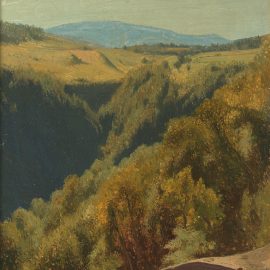
A well-known 19th-century American artist, Jervis McEntee was a prominent member of the Hudson River School recognized for his expressive autumnal landscapes.
By Chelsea DeLay
I. Biography
II. Chronology
III. Collections
IV. Exhibitions
V. Memberships
VI. Suggested Resources
VII. Notes
I. Biography
Jervis McEntee was born in Rondout, New York on July 14, 1828. During the winter of 1850–51, the twenty-two-year-old McEntee studied under Frederic Edwin Church and the two maintained a life-long friendship. McEntee married Gertrude Sawyer in 1854 and three years later the couple
A well-known 19th-century American artist, Jervis McEntee was a prominent member of the Hudson River School recognized for his expressive autumnal landscapes.
By Chelsea DeLay
I. Biography
II. Chronology
III. Collections
IV. Exhibitions
V. Memberships
VI. Suggested Resources
VII. Notes
I. Biography
Jervis McEntee was born in Rondout, New York on July 14, 1828. During the winter of 1850–51, the twenty-two-year-old McEntee studied under Frederic Edwin Church and the two maintained a life-long friendship. McEntee married Gertrude Sawyer in 1854 and three years later the couple settled in New York City, taking up residency in Richard Morris Hunt’s Tenth Street Studio Building.(1) The couple’s social life flourished in the downtown art community and they frequently were in the company of some of the biggest names in 19th-century American art; McEntee’s closest friends included Eastman Johnson, John George Brown, Sanford Gifford, John Ferguson Weir, and Worthington Whittredge.
McEntee and Gifford went on their first of several European sketching trips together in 1859; the small sketches produced on these excursions were often used as models for the final landscape paintings created in McEntee’s studio. His election to the National Academy of Design in 1861 and active membership in the Century Association cemented McEntee’s place within the ranks of the most distinguished 19th-century American artists. McEntee began to exhibit his work at the National Academy the same year he was elected membership; throughout his career, McEntee’s work was also shown at respected institutions including the Art Institute of Chicago, the Pennsylvania Academy of the Fine Arts, the Paris Exposition of 1867, the Royal Academy, and the Boston Art Club.
In 1872, McEntee became consumed with a depression that initially stemmed from financial troubles; his unhappiness was apparent on his forty-fourth birthday, when he wrote in his diary, “Sometimes I doubt if an artistic temperament is compatible with the happiest and serenest life.”(2) McEntee’s penchant for the American landscape reflected the influence from his early training under Hudson River School artist Frederic Edwin Church, but a diary entry from 1874 explained the personal influences behind his artistic preference for autumnal scenes: “Perhaps what would mark my work among that of my brother artists is a preference for the soberer phases of Nature, the gray days of November and its leafless trees.”(3)
After his wife passed away in 1878, McEntee continued to paint; he visited his sister, Lucy, in Nevada in 1881, spent five weeks camping in the Catskills in 1883, and accompanied Church on an eleven-week sketching trip throughout Mexico in 1889. When McEntee passed away in 1891, his funeral was attended by “a large number of prominent people” including John Weir and Worthington Whittredge.(4) Aside from his legacy as a prominent American landscape painter, McEntee also left behind a written record of his everyday involvement within Manhattan’s thriving art community during the 1870s and 1880s. Today, his diaries survive as a valuable glimpse into the life of a typical New York painter entailed during and after the Gilded Age.(5) His landscape paintings are featured in the permanent collections of important institutions including the Brooklyn Museum, the Century Association, Cincinnati Art Museum, The Cleveland Museum of Art, Corcoran Gallery of Art, Farnsworth Art Museum, The Metropolitan Museum of Art, National Academy of Design, New-York Historical Society, Pennsylvania Academy of the Fine Arts, and The Westmoreland Museum of American Art.
II. Chronology
1828 Born in Rondout, New York
1850–51 Studies under Frederic E. Church
1854 Marries Gertrude Sawyer
1858 Opens studio in New York City
1859 Makes European tour with Sanford R. Gifford
1861 Elected to the National Academy of Design
1863 Travels to the Adirondacks in September, visits Lake George, Lake Champlain and Lake Placid with Sanford Gifford and Richard William Hubbard
1868 Travels to Europe with his wife and Sanford Gifford; the trio spends the winter in Rome
1874 Receives invitation from the Lotus Club for life membership
1877 Visits Kanawha Falls in July
1878 Wife, Gertrude Sawyer, passes away
1879 Arrives to Easthampton on July 2; sketches in Montauk with John Ferguson Weir
1881 Travels West to Fort Halleck, Nevada to visit his sister, Lucy Andrews
1883 Spends five weeks traveling throughout the Catskills on a camping expedition
1889 Joins Frederic E. Church on an eleven-week sketching trip through Mexico
1891 Passes away in January, buried in Kingston, New York
III. Collections
Archives of American Art, Smithsonian Institution, Washington, D.C.
Bowdoin College Museum of Art, Brunswick, Maine
The Brooklyn Museum, New York
Century Association, New York, New York
Cincinnati Art Museum, Ohio
Clay Center for the Arts & Sciences of West Virginia, Charleston, West Virginia
The Cleveland Museum of Art, Ohio
Corcoran Gallery of Art, Washington, D.C.
Detroit Institute of Arts, Michigan
Farnsworth Art Museum, Rockland, Maine
The Metropolitan Museum of Art, New York, New York
The Minneapolis Institute of Arts, Minnesota
The Mississippi Museum of Art, Jackson, Mississippi
National Academy of Design, New York, New York
National Gallery of Art, Washington, D.C.
New-York Historical Society, New York
Newark Museum, New Jersey
Peabody Institute of Art, Baltimore, Maryland
Pennsylvania Academy of the Fine Arts, Philadelphia, Pennsylvania
Princeton University Art Museum, Princeton, New Jersey
Samuel Dorsky Museum of Art, New Paltz, New York
St. Johnsbury Athenaeum, St. Johnsbury, Vermont
The Westmoreland Museum of American Art, Greensburg, PA
IV. Exhibitions
1861–90 National Academy of Design, New York, New York
1862–82 Brooklyn Art Association, New York
1867 Paris Exposition, France
1872 The Royal Academy, London
1873–91 Boston Art Club, Massachusetts
1876–77, 1885, 1887 The Pennsylvania Academy of the Fine Arts Annual Exhibition, Philadelphia, Pennsylvania
1880 The Art Institute of Chicago, Illinois
1997 Beacon Hill Fine Art, Boston, Massachusetts; solo exhibition
2007 Debra Force Fine Art, Inc., New York, New York; solo exhibition
V. Memberships
Century Association
National Academy, 1861
VI. Suggested Resources
1. Falk, Peter H. “Jervis McEntee,” Who Was Who in American Art. Madison, Connecticut: Sound View Press, 1999.
2. Jervis McEntee papers, 1796, 1848-1905. Archives of American Art, Smithsonian Institution. http://www.aaa.si.edu/collections/jervis-mcentee-papers-7251.
3. McCoy, Garnett. “An Archivist’s Choice: Ten of the Best,” Archives of American Art Journal 19, no. 2, 1979.
VII. Notes
1. Garnett McCoy, “An Archivist’s Choice: Ten of the Best,” Archives of American Art Journal 19, no. 2 (1979): 5.
2. Jervis McEntee papers, 1796, 1848-1905. Archives of American Art, Smithsonian Institution., np.
3. ibid.
4. The Kingston Daily Freeman, Friday Evening. (January 30, 1891): np. http://www.aaa.si.edu/collections/container/viewer/Obituaries--283091
5. McCoy 7.
A well-known 19th-century American artist, Jervis McEntee was a prominent member of the Hudson River School recognized for his expressive autumnal landscapes.
By Chelsea DeLay
I. Biography
II. Chronology
III. Collections
IV. Exhibitions
V. Memberships
VI. Suggested Resources
VII. Notes
I. Biography
Jervis McEntee was born in Rondout, New York on July 14, 1828. During the winter of 1850–51, the twenty-two-year-old McEntee studied under Frederic Edwin Church and the two maintained a life-long friendship. McEntee married Gertrude Sawyer in 1854 and three years later the couple settled in New York City, taking up residency in Richard Morris Hunt’s Tenth Street Studio Building.(1) The couple’s social life flourished in the downtown art community and they frequently were in the company of some of the biggest names in 19th-century American art; McEntee’s closest friends included Eastman Johnson, John George Brown, Sanford Gifford, John Ferguson Weir, and Worthington Whittredge.
McEntee and Gifford went on their first of several European sketching trips together in 1859; the small sketches produced on these excursions were often used as models for the final landscape paintings created in McEntee’s studio. His election to the National Academy of Design in 1861 and active membership in the Century Association cemented McEntee’s place within the ranks of the most distinguished 19th-century American artists. McEntee began to exhibit his work at the National Academy the same year he was elected membership; throughout his career, McEntee’s work was also shown at respected institutions including the Art Institute of Chicago, the Pennsylvania Academy of the Fine Arts, the Paris Exposition of 1867, the Royal Academy, and the Boston Art Club.
In 1872, McEntee became consumed with a depression that initially stemmed from financial troubles; his unhappiness was apparent on his forty-fourth birthday, when he wrote in his diary, “Sometimes I doubt if an artistic temperament is compatible with the happiest and serenest life.”(2) McEntee’s penchant for the American landscape reflected the influence from his early training under Hudson River School artist Frederic Edwin Church, but a diary entry from 1874 explained the personal influences behind his artistic preference for autumnal scenes: “Perhaps what would mark my work among that of my brother artists is a preference for the soberer phases of Nature, the gray days of November and its leafless trees.”(3)
After his wife passed away in 1878, McEntee continued to paint; he visited his sister, Lucy, in Nevada in 1881, spent five weeks camping in the Catskills in 1883, and accompanied Church on an eleven-week sketching trip throughout Mexico in 1889. When McEntee passed away in 1891, his funeral was attended by “a large number of prominent people” including John Weir and Worthington Whittredge.(4) Aside from his legacy as a prominent American landscape painter, McEntee also left behind a written record of his everyday involvement within Manhattan’s thriving art community during the 1870s and 1880s. Today, his diaries survive as a valuable glimpse into the life of a typical New York painter entailed during and after the Gilded Age.(5) His landscape paintings are featured in the permanent collections of important institutions including the Brooklyn Museum, the Century Association, Cincinnati Art Museum, The Cleveland Museum of Art, Corcoran Gallery of Art, Farnsworth Art Museum, The Metropolitan Museum of Art, National Academy of Design, New-York Historical Society, Pennsylvania Academy of the Fine Arts, and The Westmoreland Museum of American Art.
II. Chronology
1828 Born in Rondout, New York
1850–51 Studies under Frederic E. Church
1854 Marries Gertrude Sawyer
1858 Opens studio in New York City
1859 Makes European tour with Sanford R. Gifford
1861 Elected to the National Academy of Design
1863 Travels to the Adirondacks in September, visits Lake George, Lake Champlain and Lake Placid with Sanford Gifford and Richard William Hubbard
1868 Travels to Europe with his wife and Sanford Gifford; the trio spends the winter in Rome
1874 Receives invitation from the Lotus Club for life membership
1877 Visits Kanawha Falls in July
1878 Wife, Gertrude Sawyer, passes away
1879 Arrives to Easthampton on July 2; sketches in Montauk with John Ferguson Weir
1881 Travels West to Fort Halleck, Nevada to visit his sister, Lucy Andrews
1883 Spends five weeks traveling throughout the Catskills on a camping expedition
1889 Joins Frederic E. Church on an eleven-week sketching trip through Mexico
1891 Passes away in January, buried in Kingston, New York
III. Collections
Archives of American Art, Smithsonian Institution, Washington, D.C.
Bowdoin College Museum of Art, Brunswick, Maine
The Brooklyn Museum, New York
Century Association, New York, New York
Cincinnati Art Museum, Ohio
Clay Center for the Arts & Sciences of West Virginia, Charleston, West Virginia
The Cleveland Museum of Art, Ohio
Corcoran Gallery of Art, Washington, D.C.
Detroit Institute of Arts, Michigan
Farnsworth Art Museum, Rockland, Maine
The Metropolitan Museum of Art, New York, New York
The Minneapolis Institute of Arts, Minnesota
The Mississippi Museum of Art, Jackson, Mississippi
National Academy of Design, New York, New York
National Gallery of Art, Washington, D.C.
New-York Historical Society, New York
Newark Museum, New Jersey
Peabody Institute of Art, Baltimore, Maryland
Pennsylvania Academy of the Fine Arts, Philadelphia, Pennsylvania
Princeton University Art Museum, Princeton, New Jersey
Samuel Dorsky Museum of Art, New Paltz, New York
St. Johnsbury Athenaeum, St. Johnsbury, Vermont
The Westmoreland Museum of American Art, Greensburg, PA
IV. Exhibitions
1861–90 National Academy of Design, New York, New York
1862–82 Brooklyn Art Association, New York
1867 Paris Exposition, France
1872 The Royal Academy, London
1873–91 Boston Art Club, Massachusetts
1876–77, 1885, 1887 The Pennsylvania Academy of the Fine Arts Annual Exhibition, Philadelphia, Pennsylvania
1880 The Art Institute of Chicago, Illinois
1997 Beacon Hill Fine Art, Boston, Massachusetts; solo exhibition
2007 Debra Force Fine Art, Inc., New York, New York; solo exhibition
V. Memberships
Century Association
National Academy, 1861
VI. Suggested Resources
1. Falk, Peter H. “Jervis McEntee,” Who Was Who in American Art. Madison, Connecticut: Sound View Press, 1999.
2. Jervis McEntee papers, 1796, 1848-1905. Archives of American Art, Smithsonian Institution. http://www.aaa.si.edu/collections/jervis-mcentee-papers-7251.
3. McCoy, Garnett. “An Archivist’s Choice: Ten of the Best,” Archives of American Art Journal 19, no. 2, 1979.
VII. Notes
1. Garnett McCoy, “An Archivist’s Choice: Ten of the Best,” Archives of American Art Journal 19, no. 2 (1979): 5.
2. Jervis McEntee papers, 1796, 1848-1905. Archives of American Art, Smithsonian Institution., np.
3. ibid.
4. The Kingston Daily Freeman, Friday Evening. (January 30, 1891): np. http://www.aaa.si.edu/collections/container/viewer/Obituaries--283091
5. McCoy 7.