
Childe Hassam
Artist Biography
The premier American Impressionist painter of New York City
By Alexandra A. Jopp
Childe Hassam, often referred to as the “American Monet,” is one of the most admired American Impressionists, famous for his New York City street scenes, coastal views, and rural landscapes of New England.
I. Biography
II. Chronology
III. Collections
IV. Exhibitions
V. Memberships
VI. Notes
VII. Suggested Resource
I. Biography
Frederick Childe Hassam, America’s leading Impressionist, established an impressive oeuvre with many mediums including watercolors, pastels, drawings and prints. Early in his career, Hassam established a connection with Claude Monet, but this association would become a frustration to him as he disdained comparisons to the great Frenchman, even rejected the label of Impressionist for himself. He is also known for two other styles: he became an important illustrator during the “golden age” of American illustration in the 1880s and 1890s, and he adopted many of the techniques of nineteenth-century British landscape painting, a result, in part, of his travels to England in the 1880s.
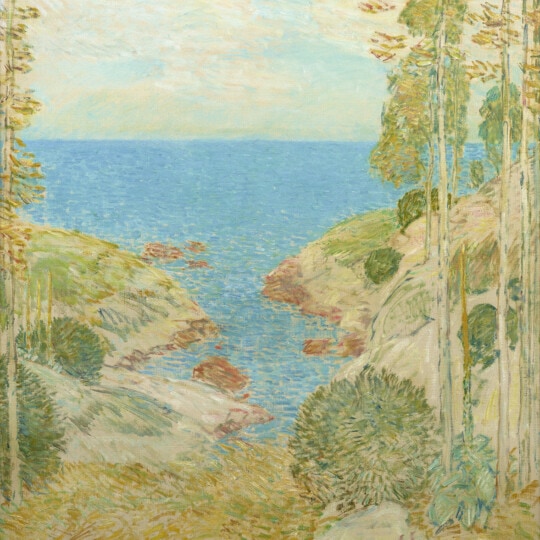
Hassam’s oils, watercolors and pastels display an intuitive sense of light and color. His works reflect knowledge of both French and English art theory, evident in his enlightened coastal and rural landscapes of New England. Hassam adopted a modern position by choosing cities as his primary subject, though today, he is also revered for the landscapes he painted during summer vacations on Appledore Island, Maine.
Hassam was born on Oct. 17, 1859, in Dorchester, Mass., to middle class parents Rosa Delia Hathorne and Frederick Fitch Hassam. From early in his life, Hassam preferred to be known by his middle name, and he signed his works “F. Childe Hassam.” Young Hassam was educated at Dorchester’s Meeting House Hill School and Dorchester High School, where he studied French, German, Latin and Greek while playing several sports. After an 1872 fire destroyed Hassam’s father’s cutlery business, he quit high school so he could work to help the family. In 1876, he started a job in the accounting department of Boston publishing house Little, Brown and Company, but he soon realized that numbers were not his strength and decided to devote his life to art.
Hassam’s art career began with training as a wood engraver and draftsman. Simultaneously, he worked as a free-lance illustrator, namely of stories for children. He also attended art classes at the Lowell Institute and the Boston Art Club during this time. Though he worked in oils and watercolor; he quickly developed a preference for the latter.
In 1883, Hassam made his first trip to Europe, visiting Great Britain, France; The Netherlands; Switzerland; Italy and Spain. While on the continent, he absorbed the painterly brushstrokes and pure colors of the Impressionists. In Paris, under their influence, his palette brightened and he discovered a love for depicting city subjects that he retained into the final years of his long and prolific career.
In 1884, Hassam married Kathleen Maude Doan, who was known as Maud. (The marriage was childless.) In the early 1880s, the couple lived in Boston, where the artist became one of a small number of American artists to paint watercolors of urban street scenes. In 1886, looking to further develop his art and style, he took Maud to Paris. They lived there for three years while Hassam attended classes at the Académie Julian. Paris, with its charm and elegance, the true “City of Light,” was captured in such Hassam paintings as Tuileries Gardens (1897) Pont Royal, Paris (1897) and Une Averse, Rue Bonaparte (1887).
After returning from Paris in 1889, the couple moved to New York City, where they would live for the next three decades. Soon after his arrival, Hassam helped to found the New York Watercolor Club and was elected its first president. From 1890 to 1894, he focused on flower painting. It was also during this period that he completed what are probably his best known illustrations – pictures for An Island Garden by his friend Celia Thaxter, a New England poet. In the late-19th and early-20th century, he painted images from Maine’s Appledore Island, finding that “the rocks and the sea are the few things that do not change and they are wonderfully beautiful.”[1] From 1916 to 1919, he created his famous images of flags of the United States and its allies that at least one scholar has characterized as Hassam’s contribution to the war effort. He received what he considered to be the greatest honor of his career in 1920 when he was elected to the Academy of Arts and Letters, an organization to which he left several hundred artworks after his death in 1935.
As his career developed, Hassam became progressively more insistent on English dominance in art. Though he had made a reputation as an Impressionist, he never considered himself to be an Impressionist and, in fact, claimed that he had learned little from French styles. His approach, he said, was built upon English watercolor traditions.
A painter of light and beauty, Hassam is one of the premier and most prolific American artists. He produced “thirty or forty paintings in the time that other artists labored to complete six or seven, so he had always a supply of fresh works for the many exhibits around the country and abroad, even when his canvases sold briskly to collectors.”[2] His Impressionism depended on something more than painterly pursuit of pleasure or taste for light and color. He has been called “an American Sisley,” and “an American Monet” for his bright tones, dynamic brushwork and light-filled city subjects. The art of Hassam has a distinct aesthetic and cultural aspect, visible in its union of visual reality and American freedom.
II. Chronology
1859 Born on Oct. 17 in Dorchester, Mass.
1876 Apprenticed as a wood engraver in Boston; worked as an illustrator for magazines and book publishers
1877-78 Attended evening classes at the Boston Art Club. Temporarily enrolled in Lowell Institute; studied under Dr. William Rimmer
1879-81 Set up studio as a free-lance illustrator, particularly of stories for children
1879 Studied painting with I.M. Gaugengigl in Boston
1882 First one-man exhibition, “Water Colors by Fred C. Hassam,” held at the Williams and Everett Gallery, Boston.
1883 First trip to Europe; visited Great Britain, France, The Netherlands, Switzerland, Italy and Spain
1884 Married Kathleen Maude Doan on Feb. 1
1884 Began painting urban street scenes, one of a small number of American artists to do so at the time
1886 Left with Maud for his second trip to Europe; settled in Paris, where he studied drawing at the Académie Julian with Gustav Boulanger and Jules Lefebvre
1886 Painted Summer Evening
1887 Exhibited at the Paris Salon as Childe Hassam; began to work in Impressionist style
1888 Exhibited at the Paris Salon and at the third International Art Exhibition, Munich
1889 Exhibited at Exposition Universelle, Paris, where he was awarded a bronze medal; exhibited at Galerie Georges Petite, Paris; spent half of the summer in England
1889 Sailed to New York in October; assisted in founding of New York Watercolor Club and elected its first president.
1889-90 Painted Winter in Union Square
1890 Joined Pastel Society, New York
1890 Painted Celia Thaxter's Garden, Isles of Shoals, Maine
1891 Exhibited four watercolors at Art Institute of Chicago
1892 Won silver medal at the sixth International Art Exhibition, Munich; won Gold Medal for Watercolor at 2nd Annual Exhibition of Water Colors and Pastels, Philadelphia
1893 Took a new studio in the Rembrandt Studio building in New York; exhibited oils and watercolors at World’s Columbian Exposition, Chicago; awarded several prizes
1894 Houghton Mifflin and Co. published Celia Thaxter’s An Island Garden, illustrated by Hassam; the book is a success.
1895 Awarded a Webb Prize, 17th Annual Exhibition, Society of American Artists, National Academy of Design
1896 Auction of 205 of his oils, watercolors and pastels held at the American Art Galleries, New York. In December, left for Europe with Maud, settling in Naples, Italy
1897 Founded Ten American Painters Group with J.H. Twachtman and J. A. Weir; elected to membership in Lotos Club, New York
1898 Won silver medal at the 3rd Annual Exhibition, Carnegie Institute, Pittsburgh; first exhibition of the Ten American Painters held at Durand-Ruel Galleries, New York, followed by one at St. Botolph Club; Hassam included in Salon de la Societe Nationale des Beaux-Arts, Paris
1898 Taught at Art Students League, New York
1899 Awarded Temple Gold Medal, Pennsylvania Academy of the Fine Arts 68th Annual Exhibition
1899 Three Cities by Childe Hassam published with illustrations of 49 works in various media depicting New York, London and Paris
1900 Awarded silver medal at Exposition Universelle, Paris.
1910 Fourth and last trip to Europe; worked in Paris and Spain
1912 Won William A. Clark Prize and gold medal, Corcoran Gallery of Art, Washington, D.C., and Evans Prize, American Water Color Society, New York
1913 Ten works accepted by the famed Armory Show
1916-19 Absorbed in the creation of a series of paintings known as the Flag Series; pictures represent definitive development of his Impressionist manner
1917 Painted Allies Day, May 1917
1917 Began to work in lithography
1920 Elected to American Academy of Arts and Letters, New York; received Gold Medal of Honor for lifetime achievement from Pennsylvania Academy of the Fine Arts, Philadelphia
1931 Awarded Pennell Memorial Gold Medal for Etching, Pennsylvania Academy of the Fine Arts
1933 Publication of Complete Etched Work of Childe Hassam by Leonard Clayton Gallery, New York
1935 Died in Willow Bend, N.Y., on Aug. 27; entire art collection bequeathed to the American Academy of Arts and Letters, New York.
III. Collections
Addison Gallery of American Art, Andover, Mass.
Amon Carter Museum, Fort Worth, Texas
Arizona State University Art Museum
Art Institute of Chicago
Ball State Museum of Art, Indiana
Bowdoin College Museum of Art, Maine
Brauer Museum of Art at Valparaiso University
Brooklyn Museum of Art, New York City
Butler Institute of American Art, Ohio
Canajoharie Library and Art Gallery
Carnegie Museum of Art, Pittsburgh, Pennsylvania
Cedarhurst Center For The Arts, Mt. Vernon, Illinois
Chrysler Museum, Norfolk, Virginia
Cincinnati Art Museum, Ohio
Cleveland Museum of Art, Ohio
Corcoran Gallery of Art, Washington D.C.
Cornell Fine Arts Museum at Rollins College, Florida
Crocker Art Museum, California
Cummer Museum of Art, Jacksonville, Florida
Currier Gallery of Art, New Hampshire
Dallas Museum of Art, Texas
Dayton Art Institute, Ohio
Detroit Institute of Arts, Michigan
Farnsworth Art Museum, Rockland, Maine
Fine Arts Museums of San Francisco
Florence Griswold Museum, Old Lyme, Connecticut
Frye Art Museum, Seattle
Gibbes Museum of Art, Charleston, South Carolina
Harvard University Art Museums, Massachusetts
Hirshhorn Museum and Sculpture Garden, Washington D.C.
Hunter Museum of American Art, Tennessee
Hyde Collection Art Museum, Glens Falls, New York
Indianapolis Museum of Art, Indiana
Johnson Museum of Art at Cornell University, Ithaca, New York
Kemper Museum of Contemporary Art, Kansas City, Missouri
Maier Museum of Art at Randolph-Macon Woman's College, Virginia
Maryland State Archives
Memorial Art Gallery of the University of Rochester, New York
Memphis Brooks Museum of Art, Memphis, Tennessee
Metropolitan Museum of Art, New York City
Minneapolis Institute of Arts, Minnesota
Montclair Art Museum, New Jersey
Musée d'Orsay, Paris, France
Museum of Art at the University of Oklahoma
Museum of Fine Arts, Boston
Museum of Fine Arts, Houston, Texas
Museum of the City of New York
National Academy of Design, New York City
National Gallery of Art, Washington D.C.
Nelson-Atkins Museum of Art, Missouri
New Britain Museum of American Art, Connecticut
New-York Historical Society
Norton Museum of Art, West Palm Beach, Florida
Orlando Museum of Art, Florida
Parrish Art Museum, Southampton, New York
Portland Museum of Art, Maine
Princeton University Art Museum, New Jersey
Richmond Art Museum, Indiana
Ruth Chandler Williamson Gallery at Scripps College, California
San Diego Museum of Art, California
Sheldon Art Gallery, Lincoln, Nebraska
Smart Museum of Art at the University of Chicago
Smith College Museum of Art, Massachusetts
Smithsonian American Art Museum, Washington D.C.
Smithsonian Institution Art Inventories
Southern Alleghenies Museum, Loretto, Pennsylvania
Spencer Museum of Art at the University of Kansas
Terra Foundation for American Art, Chicago
The Newark Museum, New Jersey
The Phillips Collection, Washington D.C.
Thyssen-Bornemisza Museum, Madrid, Spain
Tweed Museum of Art at the University of Minnesota, Duluth
University of Kentucky Art Museum
Wadsworth Atheneum Museum of Art, Connecticut
Westmoreland Museum of American Art, Greensburg, Pennsylvania
Wetmore Print Collection at Connecticut College
Wichita Art Museum, Kansas
Worcester Art Museum, Massachusetts
IV. Exhibitions
1882-92, 1896 Boston Art Club
1883, 85, 87, 89, 96 American Art Galleries
1883, 91 Brooklyn Art Association
1883-89, 91, 92, 1912, 1919 American Water Color Society
1883-1935 National Academy of Design
1884, 1888-92, 99, 1906, 1910, 1919-20, 1931-35 Pennsylvania Academy of the Fine Arts
1884 Williams and Everett Gallery, Boston
1885, 1891 Museum of Fine Arts, Boston
1885, 86 Boston Water-Color Society
1886 American Art Association
1886, 1890-92, Society of American Artist
1886 The Metropolitan Museum of Art
1886-90 Inter-State Industrial Exposition of Chicago
1888-89 Paris Salon, France
1888, 1892 Internationalem Kunst-Ausstellung, Munich
1889, 1900 Exposition Universelle
1889-92, 96, 1913 The Art Institute of Chicago
1889, 91 Doll and Richards Gallery, Boston
1890 Union League Club, New York
1890 Hermann Wunderlich Gallery
1890 Paris Salon
1890, 91, 92 Rochester Art Club
1890, 91, 92 Art Club of Philadelphia
1890, 91 New York Water Color Club
1890 Fellowcraft Club
1890 Noyess, Cobb, and Co., Boston
1891, 92 Brooklyn Art Club
1891 Hamilton Place, Boston
1891 Gallerie Durand-Ruel, Paris
1891 St. Louis Exposition and Music Hall Association
1891, 92 Union League Club, New York
1891 Blakeslee Galleries, Brooklyn Eagle
1892 Portland Art Association, Oregon
1893 World’s Columbian Exposition, Chicago
1893, 1914 Macbeth Gallery, New York
1895 Cleveland Art Association
1895 Society of American Artists, New York (Webb prize)
1896, 1904, 1910 Carnegie Art Galleries, Pittsburgh
1898, 1903, 1918 Durand-Ruel Galleries, New York
1901 Pan-American Exposition, Buffalo
1903 Salon of the Societe Nationale des Beaux-Arts, Paris
1906 Galleries of the American Fine Arts Society
1906 Worcester Art Museum
1908-1910 Cincinnati Art Museum
1909, 1914-16 Montross Gallery, New York
1910, 1910-12, 1919 The Corcoran Gallery of Art, Washington, D.C.,
1913 Association of American Painters and Sculptors
1914 Panama-Pacific International Exposition, San Francisco
1914 Water Color Club
1927 American Academy of Arts and Letters
1929 Albright Art Gallery, Buffalo
1932-33 Leonard Clayton Gallery, New York
1933 Adam Clayton Gallery, New York
V. Memberships
American Academy of Arts and Letters
American Watercolor Society
Boston Art Club
Coffee House
Lotos Club
Louisville Art League
Munich Secession
National Institute of Arts and Letters
National Academy of Design
New York Water Color Club
Paint and Clay Club, Boston
Painter-Gravers of America
Pennsylvania Academy of the Fine Arts
Players Club
Salmagundi Club
Society of American Artists
Societe Nationale des Beaux-Arts, Paris
Ten American Painters
Union Club
VI. Notes
1: David Park Curry, Childe Hassam: An Island Garden Revisited, (New York and London: Denver Art Museum in association with W.W. Norton & Company, 1990), p. 14.
2: Elizabeth Broun, “Childe Hassam’s America,” American Art 13, no. 3 (1999): 33.
VII. Suggested Resources
Adelson, Warren, Jay E. Cantor and William H. Gerdts. Childe Hassam: Impressionist. New York and London: Abbeville Press, 1999.
Bullock, Margaret E. Childe Hassam: Impressionist in the West. Portland, Ore.: Portland Art Museum, 2005.
Curry, David Park. Childe Hassam: An Island Garden Revisited. New York and London: Denver Art Museum in association with W.W. Norton & Company, 1990.
Hoopes, Donelson F. Childe Hassam. New York: Watson-Guptill Publications, 1979.
Weinberg, H. Barbara. Childe Hassam, American Impressionist. New York: Metropolitan Museum of Art, 2004.